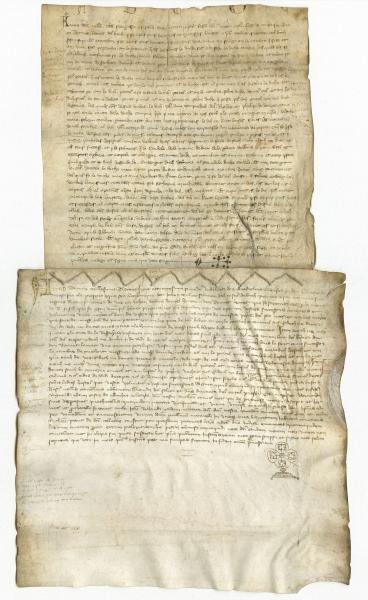
A pair of two 14th century Latin medieval acts from the Normandy region in France, handwritten on parchment in the years 1308 and 1365, from the reigns of Philip IV and Charles V of France. The charters have been stitched together. There is a small signum at the end of the first charter, and a larger, ornate signum at the end of the second. These charters have been written in a 34-line and 25-line format.
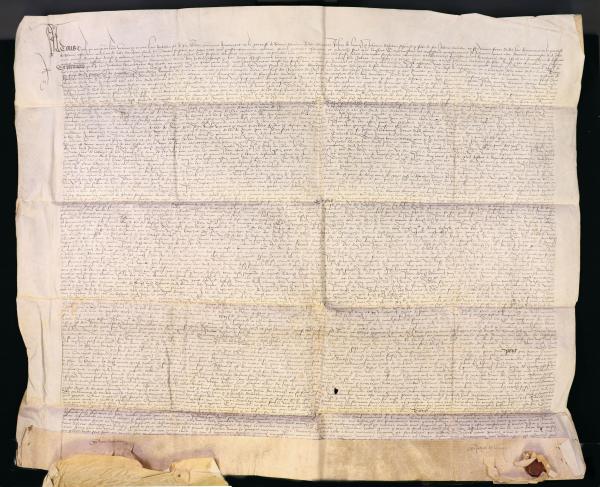
Medieval Act for one Gilles Dabelain, July 12, 1445. Two Manuscripts on Parchment. A mid-15th century medieval act, written in French and on parchment, being an original copy of the act sanctioning the division of Gilles Dabelain’s property between his children Hues and Jehanne, the latter being the wife of Jehan de Lannoy, written in the city of Lille, France, July 12, 1445. Attached to the act is a smaller, accompanying manuscript on parchment. There are three original seals at the end. The primary manuscript has been written in a 105-line format, and the attached manuscript an 18-line format.
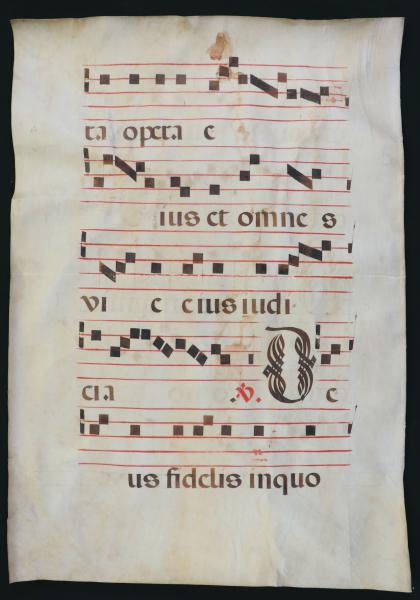
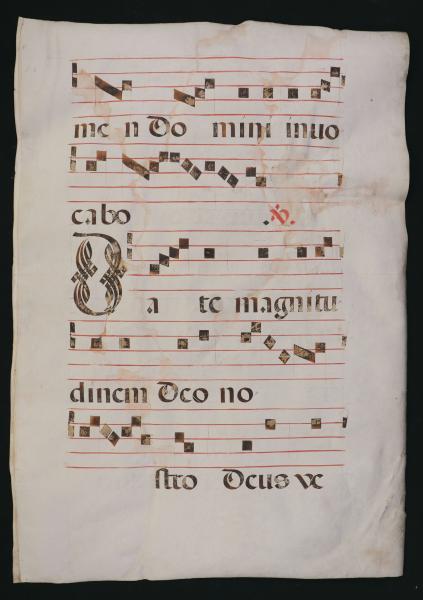
1 Vellum double-sided leaf from a liturgical music manuscript of a canticle entitled Atténde caélum used for the readings or lessons during Holy Saturday. This leaf measures 65 ½ cm. x 45 ½ cm. The first letter is of each response is illuminated. There is discoloration on the edges of the sheet and staining due to water damage. The text reads as follows: nomen Domini invocabo. V. Date magnitudinem Deo nostro: Deus, vera opera eius, et omnes viae eius indicia. V. Deus fidelis, in quo….. Translated: I will invoke the name of the Lord. V. Give ye magnificence to our God: The works of God are perfect, and all his ways are judgments. V. Let my doctrine gather as the rain, let my speech distill as the dew, as a shower upon the herb. God is faithful and without any iniquity , he is just and right.
1 Vellum double-sided leaf from a liturgical music manuscript of a canticle entitled Atténde caélum used for the readings or lessons during Holy Saturday. This leaf measures 65 ½ cm. x 45 ½ cm. The first letter is of each response is illuminated. There is discoloration on the edges of the sheet and staining due to water damage. The text reads as follows: nomen Domini invocabo. V. Date magnitudinem Deo nostro: Deus, vera opera eius, et omnes viae eius indicia. V. Deus fidelis, in quo….. Translated: I will invoke the name of the Lord. V. Give ye magnificence to our God: The works of God are perfect, and all his ways are judgments. V. Let my doctrine gather as the rain, let my speech distill as the dew, as a shower upon the herb. God is faithful and without any iniquity , he is just and right.
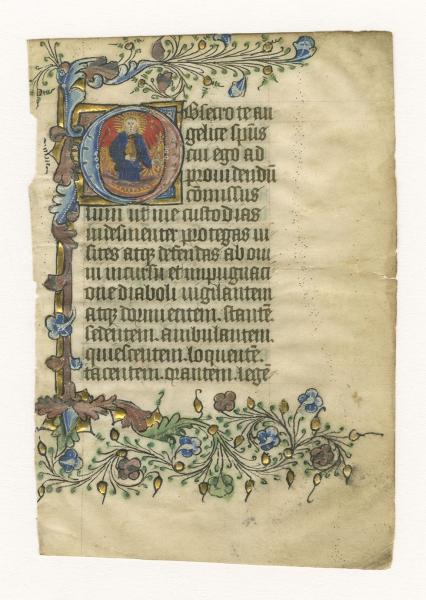
A leaf from an English Book of Hours, Use of Sarum, featuring a miniature portrait of the Virgin. The illuminated manuscript is in Latin on parchment and is from England, probably London, c. 1420. A large initial “O” (opening the Obsecro te prayer) encloses a small portrait of the Virgin holding a golden vessel. The leaf contains a single column of 14 lines of a notably spiky English, late gothic bookhand. Three of the margins contain leaves and foliage.
A leaf from an English Book of Hours, Use of Sarum, featuring a miniature portrait of the Virgin. The illuminated manuscript is in Latin on parchment and is from England, probably London, c. 1420. A large initial “O” (opening the Obsecro te prayer) encloses a small portrait of the Virgin holding a golden vessel. The leaf contains a single column of 14 lines of a notably spiky English, late gothic bookhand. Three of the margins contain leaves and foliage.
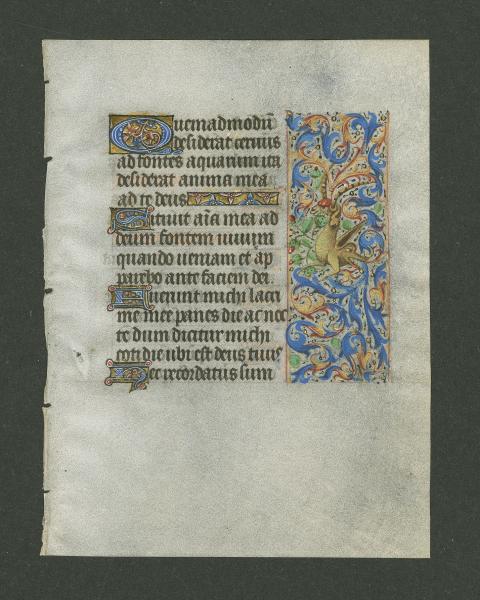
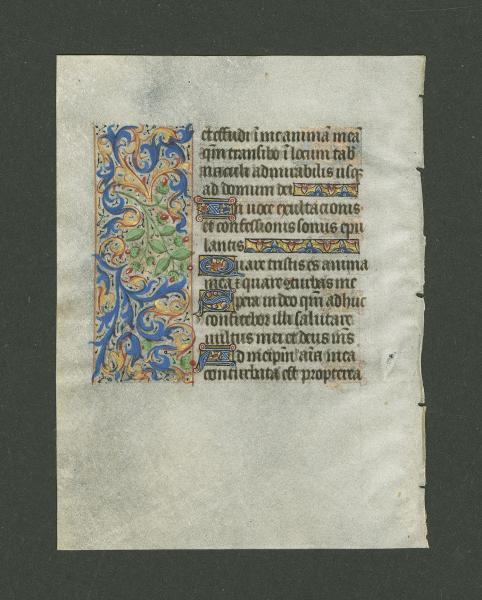
A leaf from a Book of Hours featuring a two-faced creature in the border. The illuminated manuscript on parchment is in Latin and comes from France, likely Paris, c. 1460s. The leaf contains a single column of 14 lines of a late gothic bookhand and features initials in blue touched with white on a gold background. There is one decorated border panel featuring foliage and fruit, with a fantastical creature. The creature appears to have the body of a bird, head of a long-horned goat, and a long-eared, toothy face like a crocodile with a yawning muzzle emerging from its bottom.
A leaf from a Book of Hours featuring a two-faced creature in the border. The illuminated manuscript on parchment is in Latin and comes from France, likely Paris, c. 1460s. The leaf contains a single column of 14 lines of a late gothic bookhand and features initials in blue touched with white on a gold background. There is one decorated border panel featuring foliage and fruit, with a fantastical creature. The creature appears to have the body of a bird, head of a long-horned goat, and a long-eared, toothy face like a crocodile with a yawning muzzle emerging from its bottom.
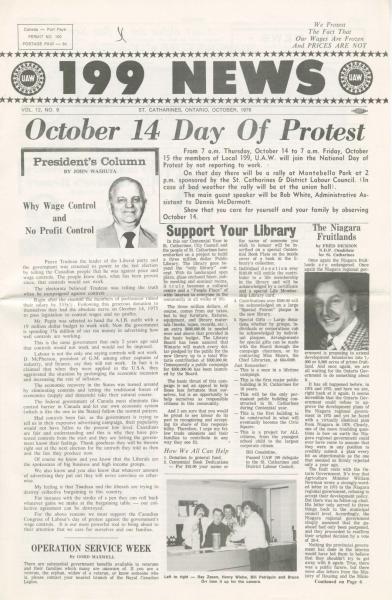
An issue of 199 News for October 1976. This issue includes: October 14 Day of Protest, Why Wage Control and No Profit Control, Operation Service Week, Support Your Library, The Niagara Fruitlands, Wage Controls: Phase Two, Badminton, Smoking, Can't Refuse Job if Bass Says It's Safe, Insurance Views, Strike Payment Eligibility, UAW Lounge Wining and Dining Menu, One Year Later, Why Me? Controls Are Completely Unfair, Quiz on Income and Taxation, Do You Know?, The Industrial Safety Act and You, Your Credit Union Provides Life Savings Insurance Cover of Up To $4,000.00, GM Chairman's Column, High Fashion Can Be Costly, UFW Boycott of Sunmaid Cancelled, Got a Lot of Living To Do?, Trudeau Must Go, Scholarships and Bursaries, Why Me? They Won't Control Prices, Obituaries.
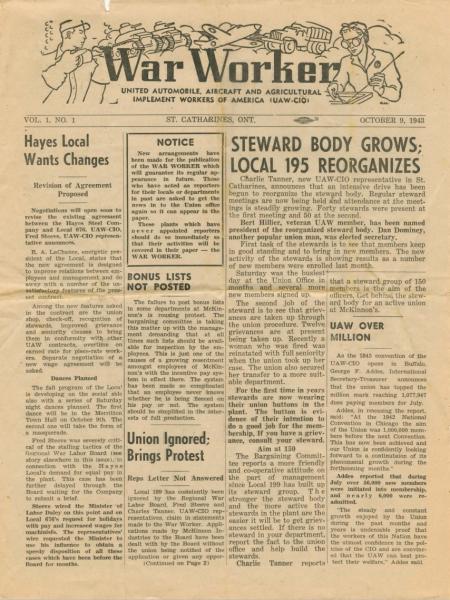
An issue of the publication "War Worker" published by the United Automobile, Aircraft and Agricultural Implement Workers of America (UAW-CIO). The issue includes: Hayes Local Wants Change, Union Ignored; Brings Protest, Steward Body Grows; Local 195 Reorganizes, UAW Over Million, Why Join a Union?, Jobs For All After the War, Bulletin Board, Niagara United Labor Committee Meets Institute, Wire Daley Over Delay, UAW-CIO Representative's Son Gets Wings and Commission, UAW Enters Hamilton, Massey-Harris Goes UAW.
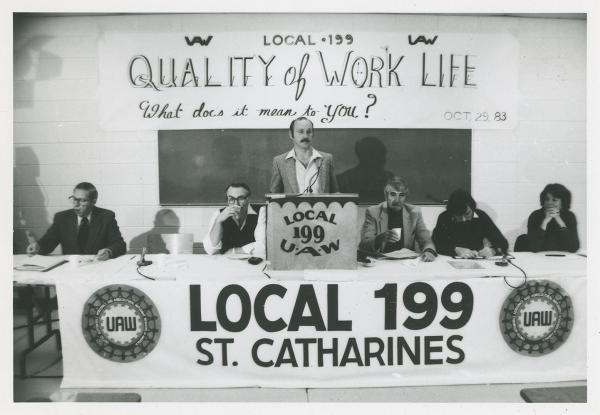
A photograph of a panel of participants at a Local 199 UAW meeting in St. Catharines, Ontario. The poster behind the speaker reads "Local 199 Quality of Work Life. What does it mean to you?". There are five people shown seated at the panel table and one speaker at the podium.
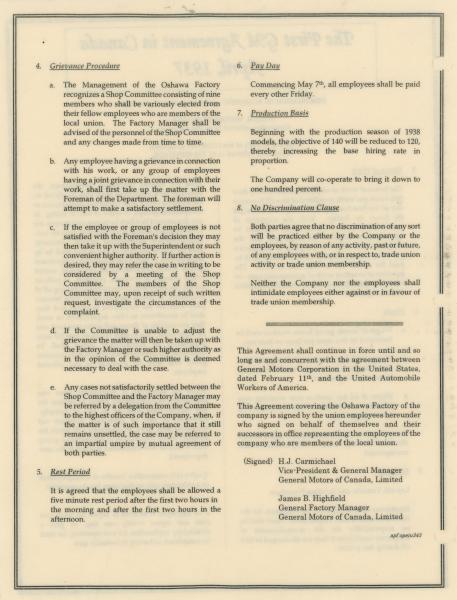
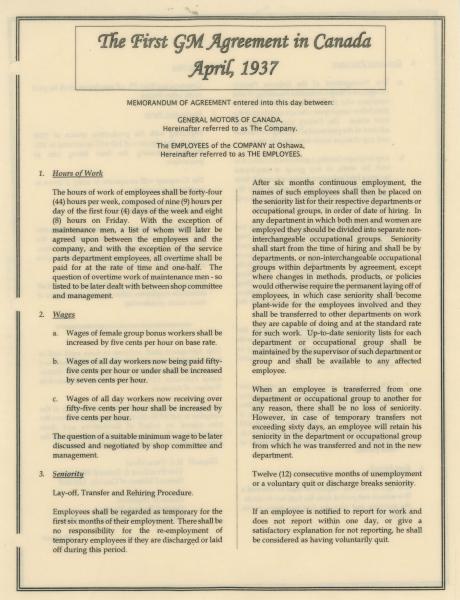
A copy of the first GM agreement in Canada from April 1937. The two page document is sorted into the following subheadings: Hours of Work, Wages, Seniority, Grievance Procedure, Rest Period, Pay Day, Production Basis, No Discrimination Clause.
A copy of the first GM agreement in Canada from April 1937. The two page document is sorted into the following subheadings: Hours of Work, Wages, Seniority, Grievance Procedure, Rest Period, Pay Day, Production Basis, No Discrimination Clause.
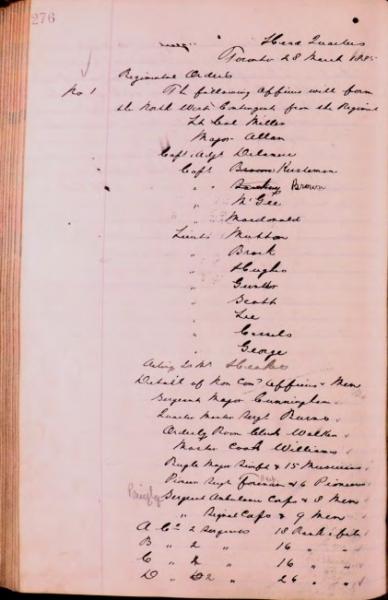
A list of officers involved with the North West contingent during the North West rebellion, from a Queen's Own Rifles Regimental Order book, March 28, 1885
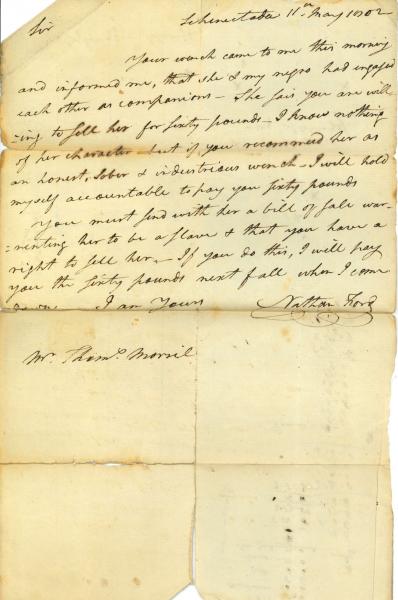
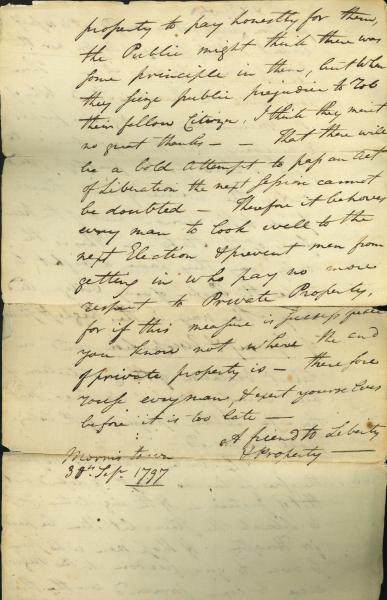
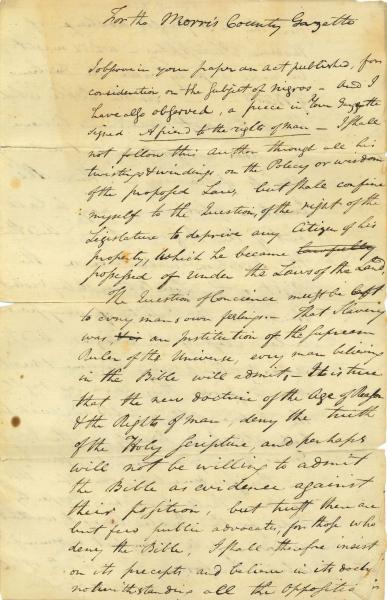
A letter to Thomas Morril from Nathan Ford about their slaves, May 11, 1802. Ford writes that Morril’s slave came to him that morning and informed him that she and his slave had engaged each other as companions. Ford states that he will take
her for sixty pounds if Morril can vouch for her as honest, sober, and industrious.
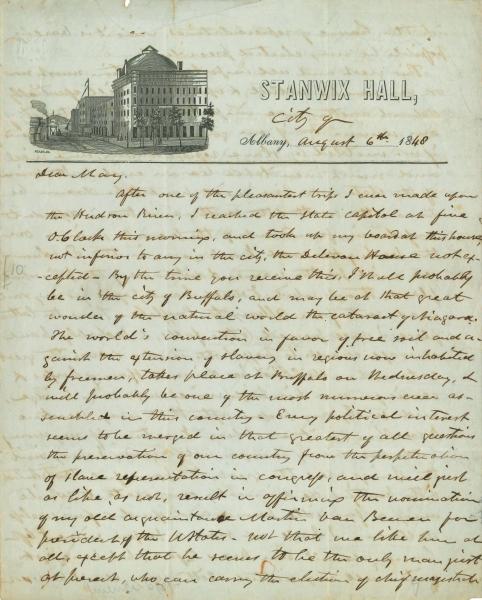
A letter from B.H. Thompson, dated at Stanwix Hall, Albany, August 6, 1848, to Mary Thompson, New York. The letter describes Thompson’s trip from New York to Albany, and from there to Buffalo and Niagara Falls. He comments on the sites he expects to see on his trip, including a trip to Niagara Falls and the Free Soil Convention in Buffalo.
Contribute
Login or click your token link to add a new record.