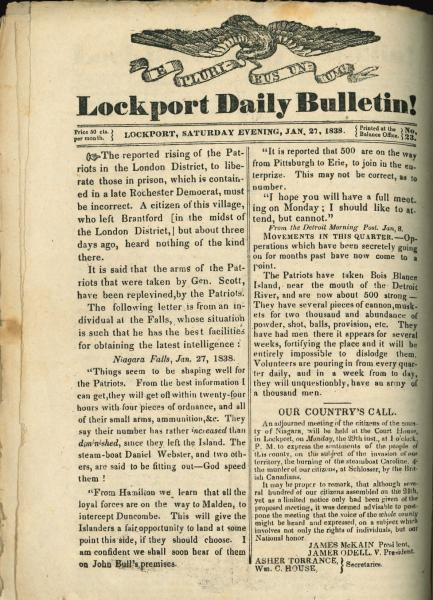
An issue of the Lockport Bulletin with news about the movements of the Patriots during the Upper Canada rebellion, and a meeting notice in Lockport about the Caroline incident, January 27, 1838.
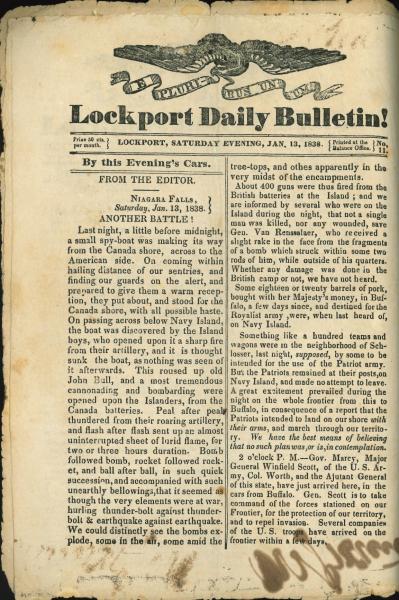
An issue of the Lockport Daily Bulletin that contains news of a battle between the rebels on Navy Island and the British on the Canadian shore during the Upper Canada rebellion, January 13, 1838.
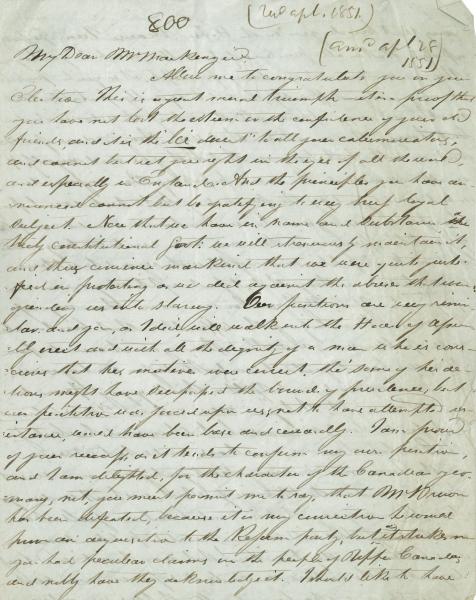
A letter to William Lyon Mackenzie from Wolfred Nelson, dated April 28, 1851. Nelson congratulates Mackenzie on his election to Parliament as the representative for Haldimand County. Nelson was also a member of Parliament who represented Richelieu. The two men were both reformers who were prominent figures in the Upper and Lower Canada Rebellions in 1837 and 1838.
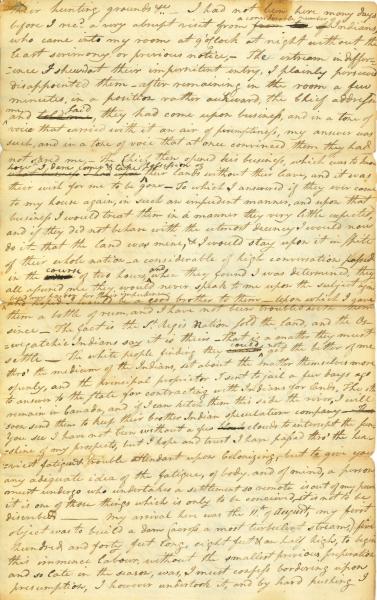
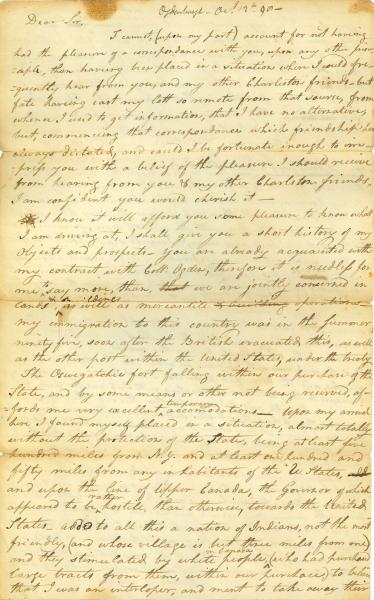
Letter to Timothy Ford, October 12, 1798. The letter concerns a new settlement that the writer is establishing. He comments on an Indigenous Chief he encountered who questioned how he came to take possession of those lands without their leave.
Letter to Timothy Ford, October 12, 1798. The letter concerns a new settlement that the writer is establishing. He comments on an Indigenous Chief he encountered who questioned how he came to take possession of those lands without their leave.
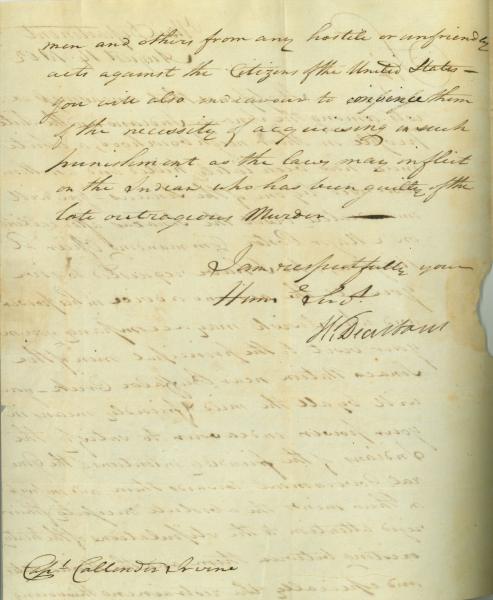
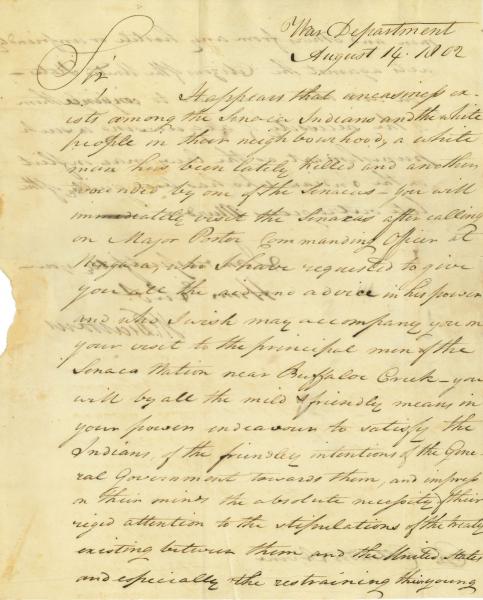
A letter by Henry Dearborn, Secretary of the War Department, to Captain Callender Irvine, Indian agent to the Six Nations. The letter concerns tensions between the Seneca Indians and those living in the vicinity of the Canadian border.
A letter by Henry Dearborn, Secretary of the War Department, to Captain Callender Irvine, Indian agent to the Six Nations. The letter concerns tensions between the Seneca Indians and those living in the vicinity of the Canadian border.
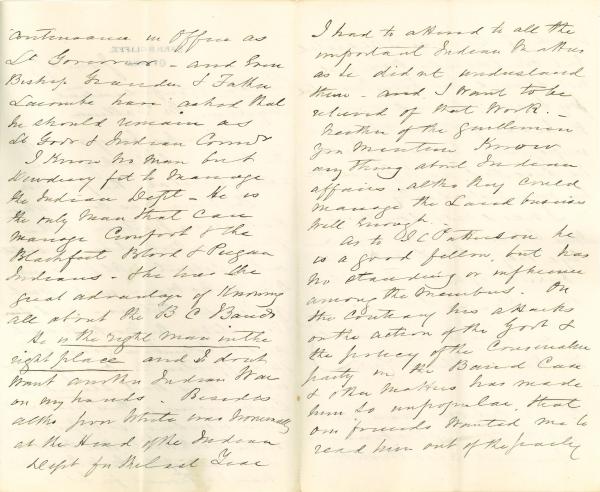
Letter from John A. Macdonald to Lachlan McCallum, June 2, 1888 in which he comments on relations with the Indigenous people and who he sees fit to manage the Indian department
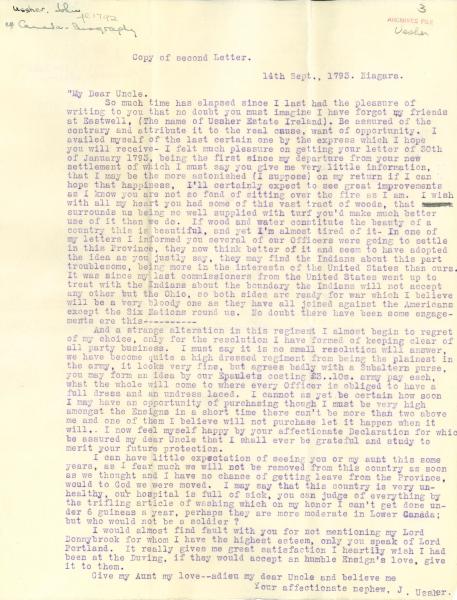
A letter written by John Ussher to his uncle, Niagara, September 14, 1793. He comments on the Indigenous people in the area and the potential for conflict.
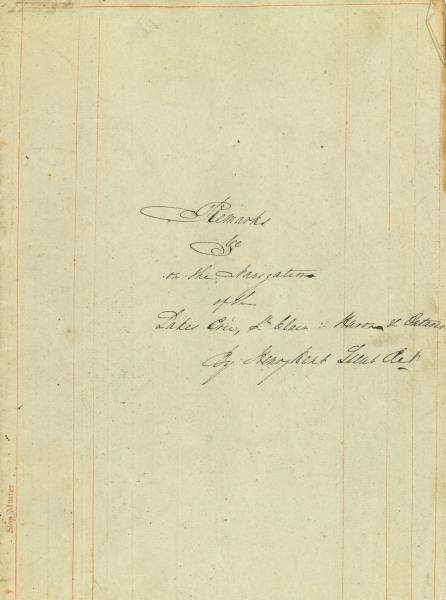
The cover of an unpublished manuscript report titled Remarks & c on the Navigation of the Lakes Erie, St. Clair, Huron & Ontario by Henry Kent, Lieut., R.N. [Royal Navy].
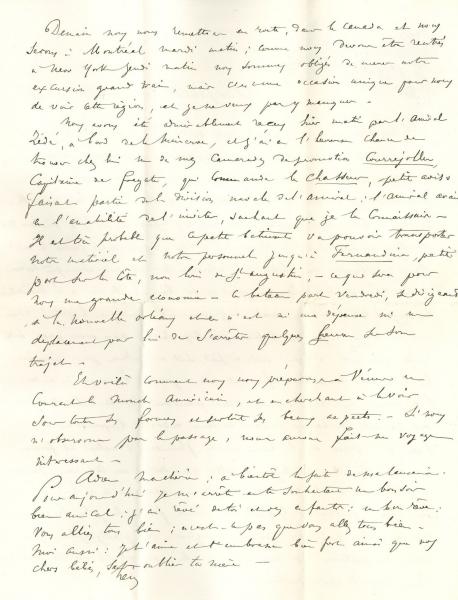
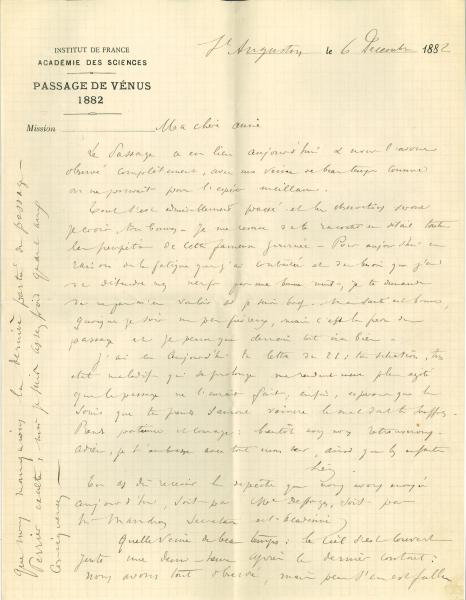
Letter addressed to Madame Bassot, 15 rue Tronchet, Paris. The letter is dated at St.
Augustine, 6 December 1882 and is one page. It is written on letterhead of the Institut
de France Academie Des Sciences Passage de Vénus 1882. He writes that the transit took
place today and we observed it completely. Everything has gone wonderfully well and he
thinks the observations will be very good. The sky was covered just half an hour after the
last contact. They saw everything but almost missed the last part of the passage. Perrier
is ecstatic.
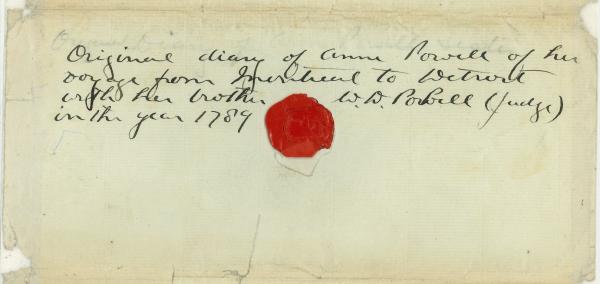
A cover sheet of the diary of Anne Powell on her voyage from Montreal to Detroit with her brother W.D. [William Dummer ] Powell (later Chief Justice of Upper Canada), 1789. It was written on her return to Montreal. During the trip she observed a Six Nations Council, describing the dress and manners of the tribal people. She wrote a lengthy description of her impressions of Mohawk Chief David Hill (Karonghyontye) and, to a lesser extent, Seneca Chief Red Jacket (Sagoyewatha). She also mentions encounters with Peter Hunter (later Lieutenant Governor of Upper Canada); Lord Edward Fitzgerald; and Mohawk Joseph Brant. Thomas Smith (later clerk of the Court of the District of Hesse, a member of the Michigan Militia, killed at the Battle of Fallen Timbers) is also mentioned.
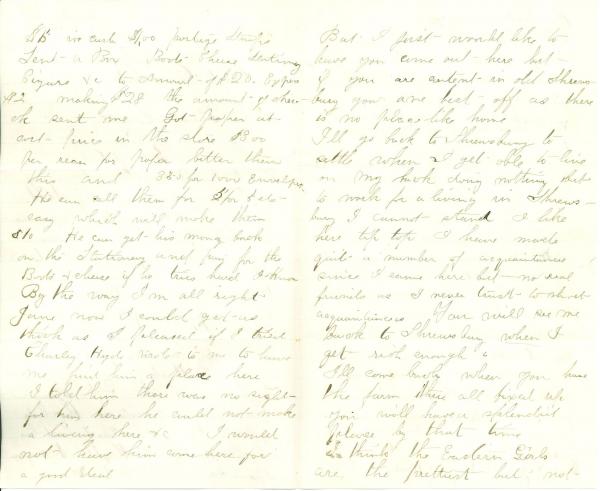
Letter written by Charles Dean to his friend Everett Walker of Shrewsbury, Massachusetts. Several letters refer to places and events in the Niagara region. Dean visited Niagara Falls and describes his visit in detail a letter dated August 11, 1869. He also comments on the Fenian uprising in two separate letters, and compares the suspension bridge being built over the Ohio River to the suspension bridge over the Niagara River. Many of his letters also refer to the American Civil War.
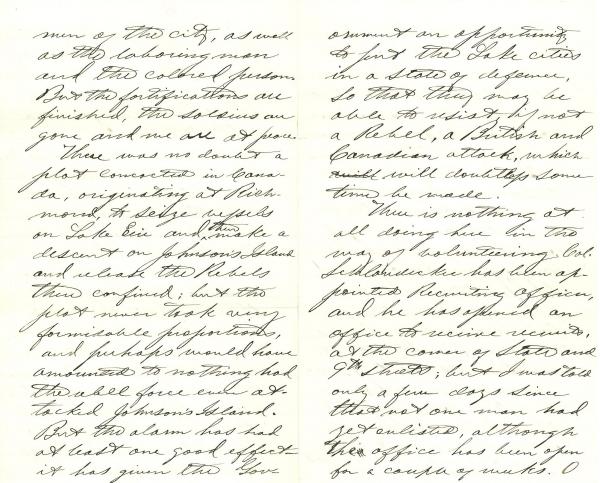
A letter by Andrew C[aughey] to Lieut. Col. D.B. McCreary, 145th Regt.,
Army of the Potomac, Washington, D.C. The letter is dated at Erie, PA,
November 25-26, 1863 and contains 18 pages. The envelope the letter was
mailed in is included. The letter was written during the American Civil War
and mentions plans of a rebel attack from Canada.
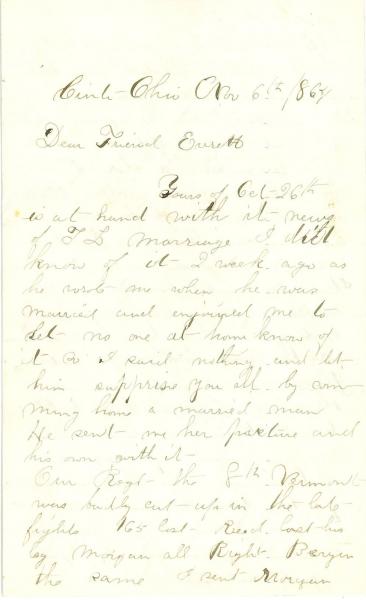
A letter about about the Battle of Cedar Creek, “Our Regt the 8th Vermont was badly cut-up in the late fights…Reed lost his leg…Next Tuesday is election
and then Old Abe will be reelected I’ll guarantee…I hope Old Abe will call for 500,000 more
men as soon as he is reelected and end the war immediately.”
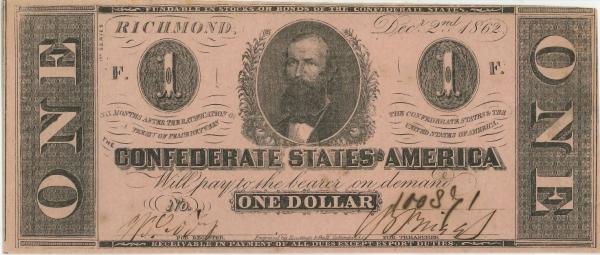
A one dollar bank note issued by the Confederate States of America, December 2, 1862. The note features a portrait of Clement Claiborne Clay, a spy for the Confederate War Department whose work to coordinate the activities of Confederate sympathizers brought him to the Great Lakes area, including Niagara. The bill is printed in black ink on pink paper and is inscribed “Fundable in stocks or bonds of the Confederate States. Six months after the ratification of a Treaty of Peace between the Confederate States & the United States of America. Confederate States of America will pay to the bearer on demand one dollar receivable in payments of all dues except export duties”. The note is engraved by Keatinge & Ball, Columbia, S.C.
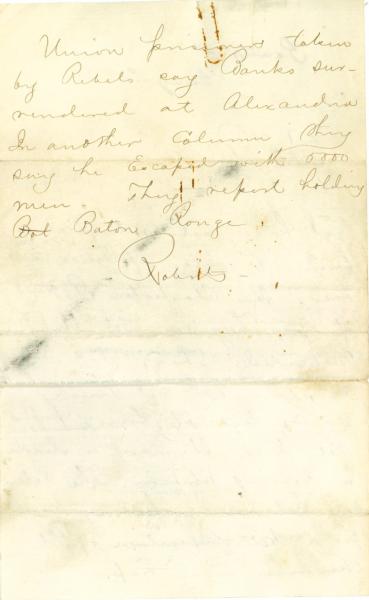
Letter to Captain Sheldon from “Roberts”, dated at Beaufort, May 20. The letter is two
pages. The writer states that he has just returned and saw in the Charleston Papers that
they are cut off from Richmond. He thinks by the tone that Gen. Sherman is steadily
driving Johnson. The Rebels say Johnson is falling back for a better position to get
Sherman in a trap. Union prisoners taken by Rebels say banks surrounded at Alexandria.
In another column they say he escaped with 5000 men. They report holding Baton Rouge.
Contribute
Login or click your token link to add a new record.