Grape Breeding Program
A grape breeding program was established in 1913, but little progress was made to improve the assortment of grape wine varieties until 1948. The program was under the leadership of Ollie Bradt beginning in 1943, and there were exciting developments during his tenure. Around this time, new crosses were developed that possessed the winter hardiness of the North American labrusca varieties and the more desirable flavour components of new French hybrids. These plants were closely monitored for disease resistance and winter hardiness by a team of scientists at Vineland Station.
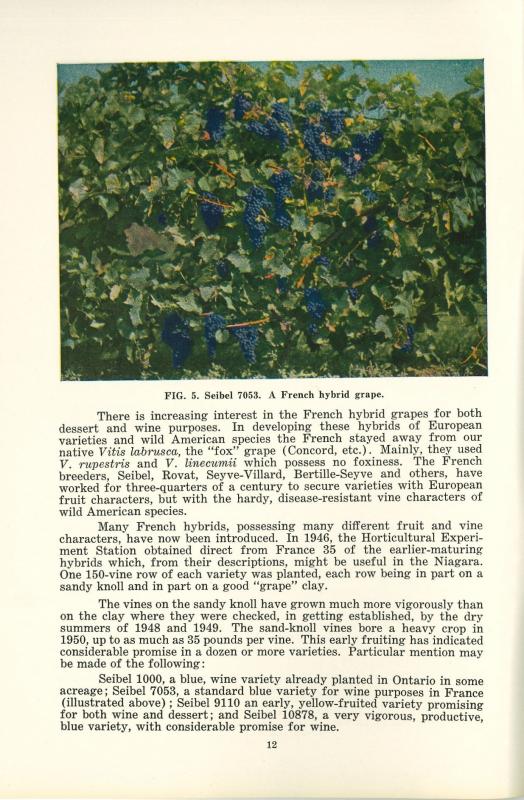
The 1949-1950 Horticultural Experiment Station's Annual Report includes a progress report on the grape breeding program, where it is noted that "there is increasing interest in the French hybrid grapes for both dessert and wine purposes. In developing these hybrids of European varieties and wild American species the French stayed away from our native "Vitis labrusca", the "fox" grape (Concord, etc.). Mainly they used "V. rupestris" and "V. linecumii" which possess no foxiness. The French breeders, Seibel, Rovat, Seyve-Villard, Bertille-Seryve, and others have worked for three-quarters of a century to secure varieties with European fruit characters, but with the hardy, disease-resistant vine characters of wild American species.
Many French hybrids, possessing many different fruit and vine characters have now been introduced. In 1946, the Horticultural Experiment Station obtained direct from France 35 of the earlier-maturing hybrids, which, from their descriptions, might be useful in the Niagara. One 150-vine row of each variety was planted, each row being in part on a sandy knoll and in part on a good "grape" clay.
The vines on the sandy knoll have grown much more vigorously than on the clay where they were checked, in getting established, by the dry summers of 1948 and 1949. The sand-knoll vines bore a heavy crop in 1950, up to as much as 35 pounds per vine. This early fruiting has indicated considerable promise in a dozen or more varieties. Particular mention may be made of the following:
Seibel 1000, a blue, wine variety already planted in Ontario in some acreage; Seibel 7053, a standard blue vareity for wine purposes in France; Seibel 9110, an early yellow-fruited variety promising for both wine and dessert; and Seibel 10878, a very vigorous, productive, blue variety with considerable promise for wine."
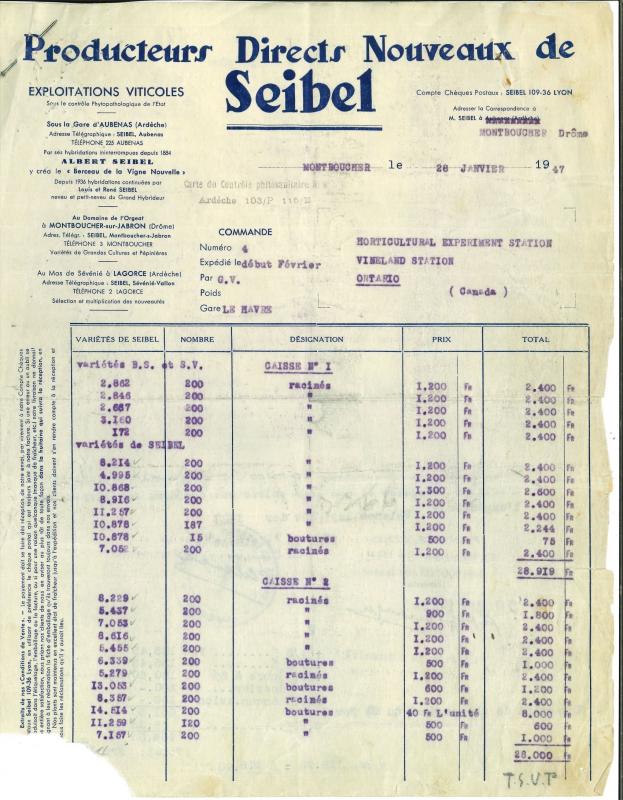
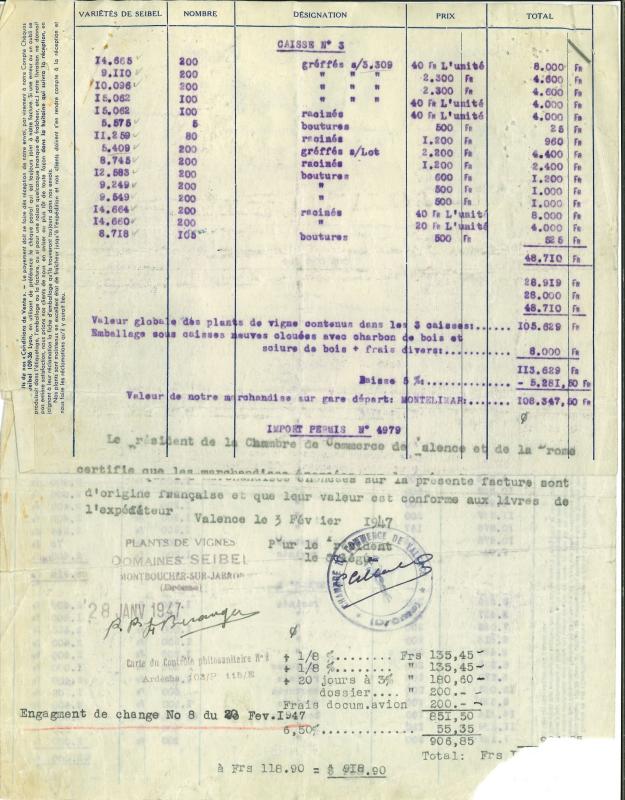
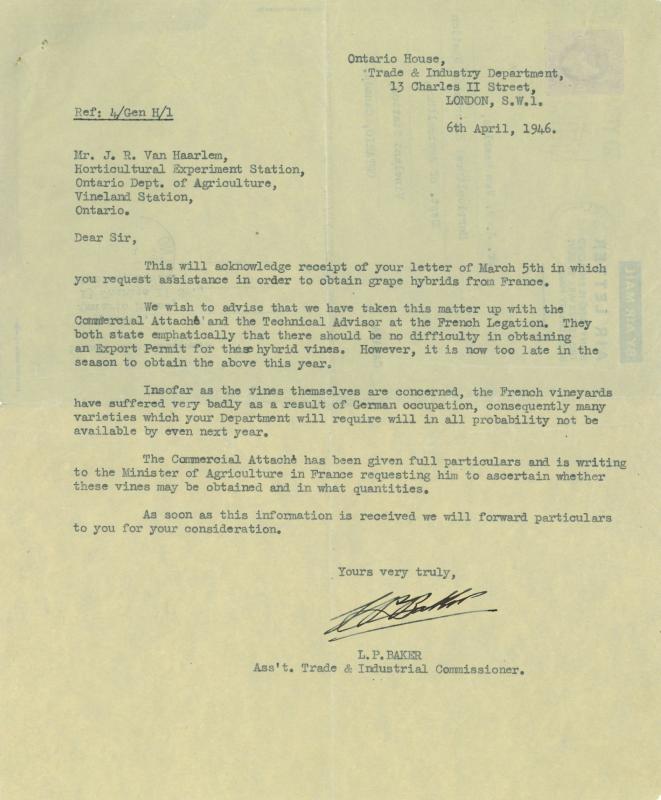
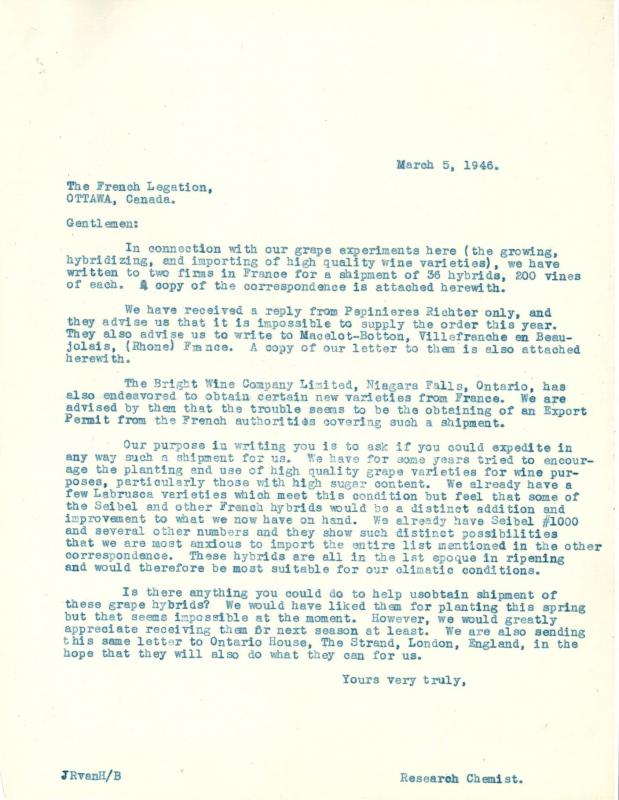
There proved to be some difficulty in obtaining vines from France. A letter written in 1946 by a research scientist at the Horticultural Research Station to the French Legation in Ottawa indicates that the problem was apparently the result of difficulties in obtaining an Export Permit from the French Authorities. The Station asks for government intervention to assist in the matter. The reply from the Trade and Industry Department in London notes "that we have taken this matter up with the Commercial Attache and the Technical Advisor at the French Legation. They both state emphatically that there should be no difficulty in obtaining an Export Permit for these hybrid vines. However, it is now too late in the season to obtain the above this year. Insofar as the vines themselves are concerned, the French vineyards have suffered very badly as a result of German occupation, consequently many varieties which your department will require will in all probability not be available by even next year..."