Exhibit Essay
Spirt, or Letters to Life
By Cassandra Getty
Each spring, graduating students from Brock University’s Visual Arts Honours Studio program develops an exhibition that marks the end of their years of study. For the April 2024 iteration, a wide range of artworks are spread over two venues: the school’s onsite VISA Gallery and the nearby Niagara Artists Centre. Engaged in these efforts, the emerging artists select a title to symbolize the spirit behind their efforts. See You Tomorrow is an apt choice that speaks to their experiences as a team and as individuals.
As I know from my own undergraduate experience, art students transform swiftly over four years, benefitting from learning in a group that is particularly small and close-knit in the university. Unlike other fields of study, the greater number and intensity of studio courses means that students live together, creating, deconstructing, and finding new possibilities in their art and themselves. See You Tomorrow can then be seen as pointing to the memories and often lifelong relationships that result from this close proximity.
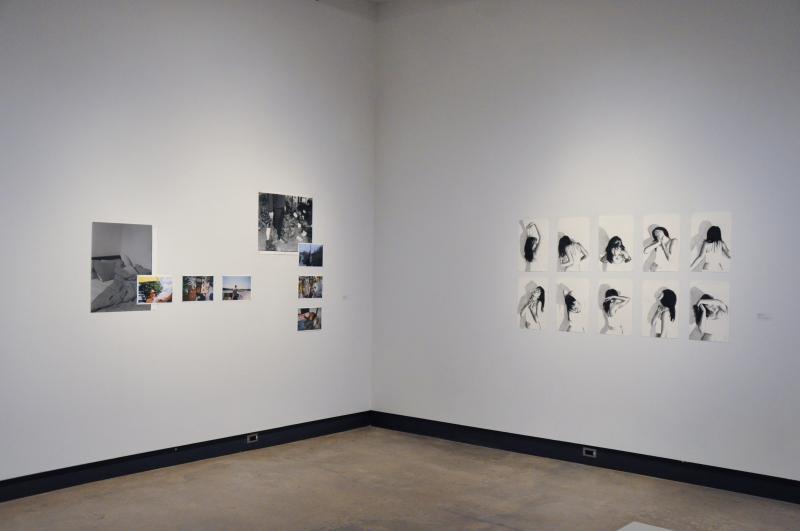
(From Right to Left) Kiveli Madentzidis, A Love Letter to Life (Series), 2024. Analogue Photography. Maddy Gordon, Gone But Not Left, 2024. Graphite and charcoal on Stonehenge.
The title is also evocative of the final year of study, where the “tomorrow” of life outside the university approaches swiftly. This time is a heady mix of going for broke with ideas, tying up loose ends, and looking to the future with elements of both ambition and ambivalence. What will they become, and what will influence their artistic view?
See You Tomorrow also captures the spirit of each artist’s practice. The exhibition features work in diverse media that considers the significance of the self and expresses deep connections to others, even encompassing ideas of universal consciousness or truth. The mention of “spirit” in the title of this text emphasizes how they explore their lives through art. Approaches range from dynamic displays of invented visual language, to glimpses of the profound in everyday life, to expressions of power found in the human body.
I thank Professors Troy Ouellette and Amy Friend for allowing me to get to know the artists: Nimea Ariana, Morgan Branton, Maddy Gordon, Mary Ivison, Alex Janecek, Abi Leeder, Kiveli Madentzidis, Isabella Saranchuk, and Sara Turavani. I also thank the students for letting me enter their studios and confidence over the last two semesters. What follows are my letters to them.
Nimea Ariana’s large-scale paintings are a confident address to other worlds. Her pared-down black-and-white works are both personal in her individualistic treatment of line, and look outwards, communicating a belief in dimensions and systems larger and older than ours. While earlier artworks employed a unique hieroglyphic language, Ariana presents the viewer with motifs of eyes, unidentified anomalous phenomena (UAPs), and labyrinthine fields of biomorphic form. These seek to combine our experience of the known world with others only beheld in visions. In one instance, this mystical effect is heightened by fluorescent black lights, which turn the paintings into a contemporary phantasmagoria display.
Mary Ivison also examines mystical ways of knowing and being. In this, she continues a long line of women surrealists and abstractionists, of which the historical contributions of many are only now being truly recognized. Ivison has also modified her focus, shifting from making masterful figurative works to concentrating on groupings of geometric shapes. Deceptively simple in their spare compositions, these glow with beautifully modulated colour and are set into configurations that suggest hermetic symbols, heavenly bodies, or unseen energies. Ivison notes that her treatment of motifs references gender, mathematics, science, and more. Her stylized renderings also seem to be part of a synaesthetic response.
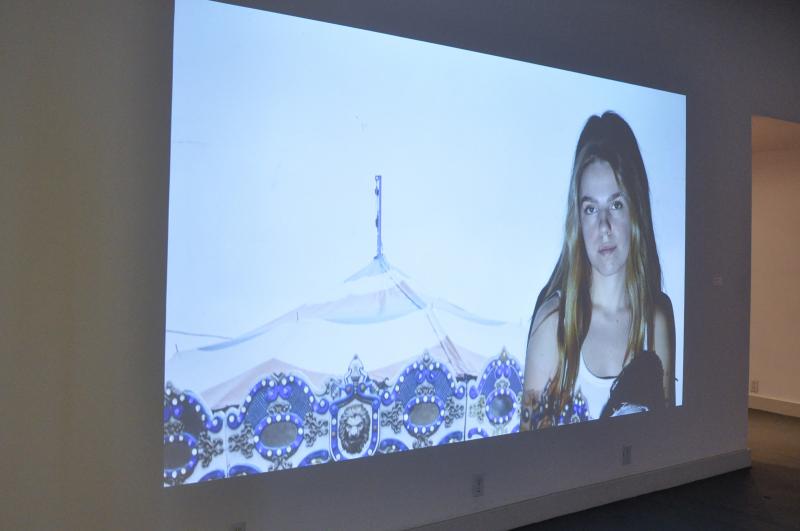
Kiveli Madentzidis, Projected Love, 2024. Video projection.
Abi Leeder is another artist who produces meditative effects from an economy of means. For her, the play of light and shadow is a mode of communication. In Didn’t Know Them Then, flat, cut paper forms are illuminated to create baroque shadows. The use of paper in art has a long global history, and Leeder adds her family’s past–figures from old family photos–to this mix. Pictures of preceding generations already strike us as enigmatic. Leeder sets them further apart by leaving out their facial features and projecting their forms as silhouettes. Characters become even more unknowable, yet viewers can make another kind of projection onto them, that of their own memories and experiences.
The work of painter Morgan Branton fully engages with ideas of family. In vivid portraits, she pays homage to her father, John Wayne Branton. Her acrylic painting series is based on photographs that encapsulate him at different stages of life, and sporting a variety of vibrant expressions that we may recognize from our own candid shots. Branton is a masterful colourist, depicting John against intense backgrounds that remove context and underscore her feelings of love, camaraderie, and respect for her father’s ingenuity and integrity. She extends her treatment of background to make complementary abstract paintings that are bright and textured, and titled with callbacks to the domestic sphere, such as Watch Your Sugar.
Kiveli Madentzidis’ lens-based work also investigates notions of family. She has worked with cyanotype and both analogue and digital photography, researching familiar scenes of the everyday for visually and emotionally evocative moments. Her latest work involves projection: she layers imagery of domestic spaces or family members over her own likeness. “I am a part of them, and they are a part of me,” she emphasizes. While Madentzidis features the figure, her face and, more often, those of her subjects are absent, obscured, or turned away from the viewer. These leave creative openings for broader contemplation by the artist and visitors.
Isabella Saranchuk also uses photographs as a jumping-off point. The largest painting in the exhibition activates the goings-on around her father’s flea market stall. A mural painter, Saranchuk works with acrylics but sets down bright underpainting in watercolour pencil to energize the scenes she then develops overtop. She notes that she portrays people to better understand herself, her family, and the world. Works such as The Flea Market reveal the sense of communion that can be intuited across an ordinary day by those insightful enough to look. They are a labour of a broader love and resilience, and a tour de force of Saranchuk’s remarkable artistic virtuosity.
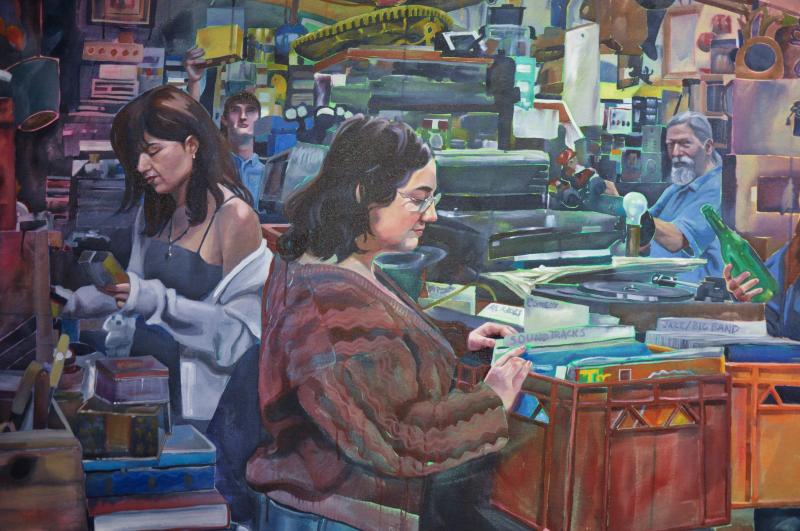
Closeup from Isabella Saranchuk, The Flea Market, 2024. Acrylic on canvas.
Considering familiar and expressive elements of the body, Alex Janecek focuses on hands. Hands are an intimate means of perceiving the world. Their gestures are also highly expressive, encompassing quick observations and intangible, abstract ideas. They communicate grief or anger through nuanced movement, accept grace, and let go. Janecek fabricates sculptural forms from beeswax and makes refined encaustic paintings. She describes both methods as versatile and calming. The fragility of wax, which the artist often leaves untreated, mirrors that of human life. The substance, moulded here by an individual but created collaboratively by thousands of insects, reflects the resilience of the individual and collective spirit.
Maddy Gordon takes the whole human body–her own–as subject matter. In large portraits in charcoal and graphite, she portrays herself sitting, stretching, and standing against a blank background. These compositions force the viewer to concentrate on her contorted likeness and, by extension, recognize the struggle to develop and maintain an identity. Gordon prefers using stark, unforgiving drawing materials against pristine supports. The high level of technical difficulty suggests a focused, strenuous artistic workout that mimics the efforts to “perfect” the body. Through her imposition of occult perspectives and duplication within what is otherwise a void, Gordon offers us a meditation on individual and societal acceptance.
Through painting and fibre work, Sara Turavani’s practice relates the making of art with the making of a way through life. On small, coloured pieces of fabric, an array of images appears. Body parts such as bones can be found alongside chairs, horseshoes, fish, and the eight ball from a pool set. Taken together, these may document a life, or suggest paths forward. Turavani has collated these elements into a “devolved” blanket of sorts. The perimeter of each fabric square is roughly basted, asserting an attractive but formidable boundary. Rather than stitching a traditional quilt pattern, strands of embroidery floss connect the patches tenuously. An association or memories may be in the process of falling apart or coalescing into a narrative.
The class of 2024 used Brock’s comprehensive studio environment to explore materials and techniques. These aided in developing skill and voice through experimentation and reflection. Congratulations are due to all nine artists, whose work proclaims inventive inner worlds, agentive identities, and the state of art practice in the 21st century. Each speculates on the familiar and envisions the unseen, and recognizes exciting potential as they embark on the next phase of their lives.