Introduction
Nimea Ariana | Morgan Sarah Jane Branton | Maddy Gordon | Mary Ivison | Alex Janecek | Abigail Leeder | Kiveli Madentzidis | Isabella Saranchuk | Sara Turavani
April 9 - May 4, 2024
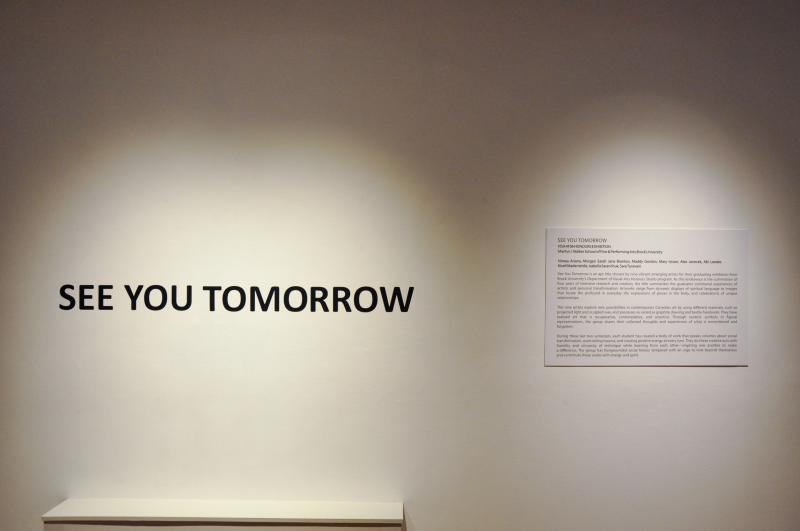
SEE YOU TOMORROW
VISA 4F06 HONOURS EXHIBITION
See You Tomorrow is an apt title chosen by nine vibrant emerging artists for their graduating exhibition from Brock University's Department of Visual Arts Honours Studio program. As this endeavour is the culmination of four years of intensive research and creation, the title summarizes the graduates' communal experiences of artistic and personal transformation. Artworks range from dynamic displays of spiritual language to images that locate the profound in everyday life, expressions of power in the body, and celebrations of unique relationships.
The nine artists explore new possibilities in contemporary Canadian art by using different materials, such as projected light and sculpted wax, and processes as varied as graphite drawing and textile handwork. They have realized art that is recuperative, contemplative, and assertive. Through esoteric symbols or figural representations, the group shares their collected thoughts and experiences of what is remembered and forgotten.
During these last two semesters, each student has created a body of work that speaks volumes about social transformation, overcoming trauma, and creating positive energy at every turn. They do these creative acts with humility and virtuosity of technique while learning from each other-inspiring one another to make a difference. The group has foregrounded social history tempered with an urge to look beyond themselves and contribute these works with energy and spirit.
The works in this exhibition are emblematic of the students' diversity of practice and research concentration. In their last year, each student has focused their ideas, putting energy and intense thought into these works that foreground their interests, respond to prevailing currents in contemporary art, and add to the discussions that circumscribe the forms they have generated.
In Mary Ivison's work, her subtle use of colour gives us pause to wonder how colour and shape affect our thoughts as sensory catalysts that allow us to calm ourselves and enter new worlds. The creation of the work may be less about what she sees and more about what others see by making things known. As the great Jazz musician Charles Mingus once remarked..."Making the simple, awesomely simple, that's creativity." This simplicity of shape or line is also typified in Maddy Gordan's work and her symbolic use of black and white to represent the dichotomies inherent in existence. In these compositions, her figure is pushed and pulled in various directions by unseen forces that shift the body in space. They convey everything from the sleepless stress of a modern world to a dream state.
There is a synergy between Maddy Gordon's and Nimea Ariana's work in that black and white often become central to their pursuits. The difference is in how Nimea's abstract works are hypnotic, transcending visual immediacy to capture a moment by charting a unique path that explores the metaphysical through immersion. Her unique critical eye is filtered through street art, graffiti, illustration, and collage, and she draws on these traditions through her imaginative insights. In both cases, these works are conduits for thought.
Returning to the figure, Isabella Saranchuk's use of tableau sets up a situation in which those depicted are unaware that anyone is looking as they search and potentially collect objects. In the work entitled "The Flea Market," it is the state of encountering that matters. The search positions the searcher in a potential treasure trove of previously undiscovered cultural artifacts and social histories. Isabella looks to her father and classmates as subjects and, at the same time, excludes herself - she is only there as the arbiter of the work - a kind of absence that foregrounds care, craft and attention to detail. In many ways, the flea market, antique stores, retro stores, and auction houses are the social history of objects existing outside the institution- circulating from one place to another all in due time.
Some of these types of objects show up in Sarah Taravania's creations, where she finds a means of navigating emotional obstacles - finding resonance and solace in the depths of expression. As she states in one of her writings …" The pure joy of creation is unencumbered by constraints or expectations." [1]
This is also evident in Alex Janacek's wax hands; we see kind gestures and fragility. The healing power of art resides here as well, connecting us all. Conceptually the matter is not necessarily in the wax itself but in the fleeting moments of immaterial action. These works find a sanctuary in art that transforms our pain, imparting a sense of purpose, meaning, and rejuvenation to our mortal bodies, giving us pause to consider the complexity in gestures of care.
This "matter of care" is also prevalent in a daughter's love of family. In Morgan Sarah Jane Branton's and Abigail Leeder's cut-out pieces, both practices become an act of acknowledgement. They exemplify the ties that bind us as a society. In Morgan's paintings, the portraits of her father reference a more extensive history of portrait painting and personal reflection. It's not always the case in portrait painting, but we often paint those we care about - and this amplifies what we revere. In some ways, we see everyone tomorrow in one way or another through emulation and remembrance. In Leeder's work, the opposite might be true if one does not quite remember something or our minds are adrift in the shadows of what once was. Abi's work embodies this. She sets up a situation for us to move through the present to experience loss but also light as it maps this psychological terrain. Other lives are never fully known to us; in this sense, they are always already lost. For Abi, the sheer act of creation embodies hope, bringing new ideas and forms to life in shadow play.
In shadowy kinship, Kiveli Madentzidis' photography and video work express self-reflection and turn the ordinary into the extraordinary by freezing a moment or having images wash over her in a video projection. In the video "Projected Love," she is depicted only looking into the light. She does not see the images we see, and in this one act, the idea that remembering is not an embodied reality for everyone all the time but is something more complex - different for everyone. Perhaps this work has more to do with a dream, but in this case, it is both an idea of a dream for the audience and simultaneously not our dream of remembrance.
Troy David Ouellette
Assistant Professor, Brock University
[1] Sara Turavani, 4F06 Research Paper on Thiago Barbaloho, 2024. Pg. 3.