Artwork
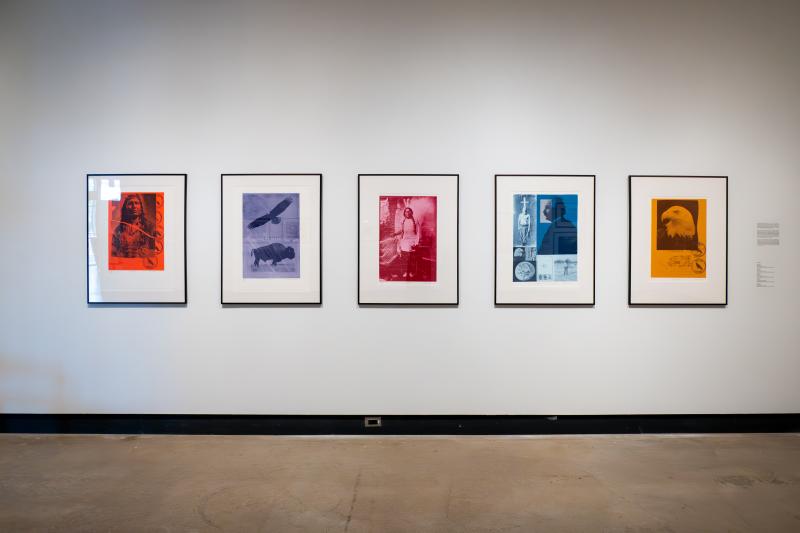
Left to right: 2002.002.003 , Carl Beam , Fragmented, 1998. Colour screen-print, ed.174/200 . Brock University Art Collection, gift of Milton Winberg, 2002.
2002.002.002 , Carl Beam , Observer, 1998 . Colour silkscreen, edition 13/200 . Brock University Art Collection, gift of Milton Winberg, 2002 .
2002.002.001 , Carl Beam , Sitting Bull, 1998 . Colour screen-print, ed. 126/200. Brock University Art Collection, gift of Milton Winberg, 2002.
2002.002.007, Carl Beam , Albert in the Blue Zone, 1998. Colour screen-print, ed. 199/200. Brock University Art Collection, gift of Milton Winberg, 2002.
2002.002.005, Carl Beam , Observer 3, 1998 . Colour screen-print, ed. 13/200. Brock University Art Collection, gift of Milton Winberg, 2002.
Carl Edward Migwans Beam, RCA (May 24, 1943 – July 30, 2005) was an Indigenous Canadian multi-media artist whose career confronted Canada's colonial legacy through innovative means of creativity. A member of the M'Chigeeng First Nation on Manitoulin Island in Ontario, Beam was one of the first contemporary Indigenous artists in Canada to gain widespread national and international recognition in the art world.
Beam made Canadian art history as the first artist of Indigenous Ancestry (Ojibwe), to have his work purchased by the National Gallery of Canada as Contemporary Art. A major retrospective of his work was organized by the National Gallery of Canada in 2010. Beam's work engaged with the contemporary issues and experiences of the Indigenous peoples of Turtle Island. He worked in various photographic mediums, mixed media, oil, acrylic, spontaneously scripted text on canvas, works on paper, Plexiglas, stone, cement, wood, handmade ceramic pottery, and found objects, in addition to etching, lithography, and screen process.
Carl Beam’s 6 coloured lithographs (five of which are installed in this exhibition) are part of Brock University's Art Collection and exemplify Beam's graphic style and storytelling abilities. Their references are broad, encompassing other cultures and identities, connecting people and diverse communities with emblematic and iconographic images that speak to our collective troubled past and optimistic future. His contemporary art-making strategies serve and empower his engagement with the struggle of Indigenous Peoples in the late 20th century.
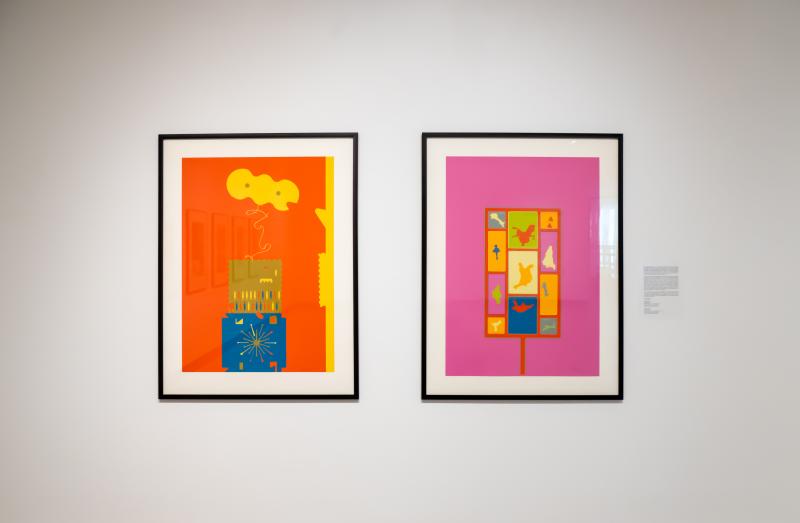
Left to Right: 1995.024.056 , Harold Town, Mask Machine – blue on red, 1973 . Colour silkscreen, edition 38/55. Brock University Art Collection .
1995.024.050, Harold Town, Child’s punchout in rear-view mirror, 1971 . Colour silkscreen, edition 26/99 . Brock University Art Collection .
Harold Barling Town (1924–1990) was a charismatic presence in Canadian art, known as much for his creative output as for his larger-than-life personality. A founding member of Painters Eleven—the group that helped put Canadian Abstract Expressionism on the map—Town was never content to stay in one lane. Over the course of his career, he moved effortlessly between painting, printmaking, drawing, collage, sculpture, and even writing. He was always experimenting, always producing.
Town gained international recognition in the 1950s for his groundbreaking printwork—his “single autographic prints” were particularly influential, blending precision and spontaneity in a way that turned heads at major exhibitions abroad. Back home, his solo shows in Toronto were major cultural events. His paintings commanded record prices and helped ignite a modern art scene in the city when it was still finding its identity.
But Town wasn't just prolific—he was sharp, articulate, and outspoken. He wrote about art passionately (and sometimes provocatively), contributing essays, criticism, and even books that gave voice to Canadian art at a time when it often struggled to assert itself. His presence extended beyond the studio: he appeared on television, mingled with cultural tastemakers, and never shied away from controversy or big ideas.
The two lithographs by Harold Town featured in Intentional Futures offer a window into his remarkable practice. They’re part of a much larger collection of several hundred lithographs and serigraphs held within the Brock University Art Collection. They are a testament to Town’s restless creativity and technical mastery.
(1924–1990) was a charismatic presence in Canadian art, known as much for his creative output as for his larger-than-life personality. A founding member of Painters Eleven—the group that helped put Canadian Abstract Expressionism on the map—Town was never content to stay in one lane. Over the course of his career, he moved effortlessly between painting, printmaking, drawing, collage, sculpture, and even writing. He was always experimenting, always producing.
Town gained international recognition in the 1950s for his groundbreaking printwork—his “single autographic prints” were particularly influential, blending precision and spontaneity in a way that turned heads at major exhibitions abroad. Back home, his solo shows in Toronto were major cultural events. His paintings commanded record prices and helped ignite a modern art scene in the city when it was still finding its identity.
But Town wasn't just prolific—he was sharp, articulate, and outspoken. He wrote about art passionately (and sometimes provocatively), contributing essays, criticism, and even books that gave voice to Canadian art at a time when it often struggled to assert itself. His presence extended beyond the studio: he appeared on television, mingled with cultural tastemakers, and never shied away from controversy or big ideas.
The two lithographs by Harold Town featured in Intentional Futures offer a window into his remarkable practice. They’re part of a much larger collection of several hundred lithographs and serigraphs held within the Brock University Art Collection. They are a testament to Town’s restless creativity and technical mastery.
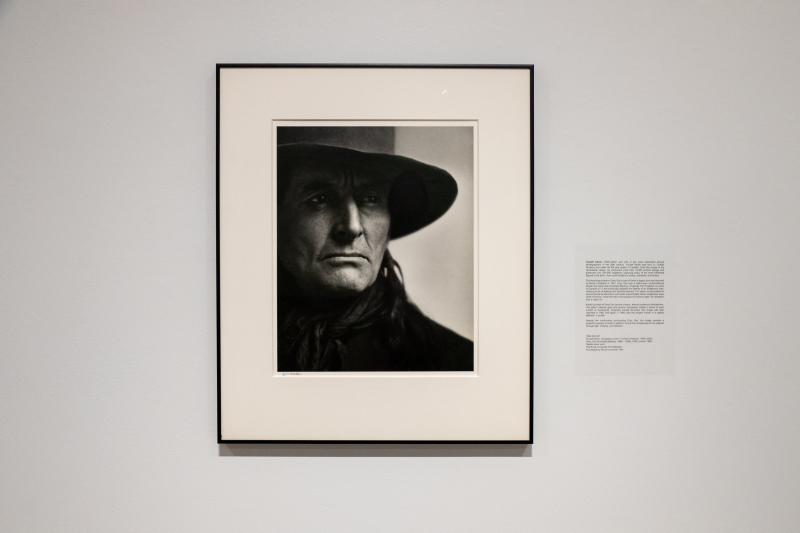
1994.004.001, Yousef Karsh, Grey Owl (Archibald Belaney, 1888 – 1938), 1936, printed 1989. Gelatin silver print. The Brock University Art Collection , Purchased by Brock University 1991 .
Yousef Karsh (1908–2002) was born in Turkish Armenia and made his life and career in Canada. Over the course of his remarkable career, he conducted more than 15,000 portrait sittings and produced over 250,000 negatives, capturing many of the most influential figures of his time—from world leaders to artists, scientists, and writers.
This portrait of Grey Owl is part of Karsh’s legacy and was acquired by Brock University in 1991. Grey Owl was a well-known conservationist whose real name was Archibald Belaney. Originally from England, he came to Canada at 17 and eventually adopted the identity of an Indigenous man, claiming to be of Apache and Scottish descent. For years, he advocated for environmental preservation and spoke passionately about Indigenous ways of life. However, once the truth of his background came to light, his reputation took a major hit.
Karsh’s portrait of Grey Owl carries a heavy, almost mysterious atmosphere. The sitter’s intense gaze and solemn expression create a sense of inner conflict or foreboding. Originally printed life-sized, this image was later reprinted in 1963 and again in 1989, with the subject shown in a slightly different, ¾ profile.
Despite the controversy surrounding Grey Owl, this image remains a powerful example of Karsh’s ability to reveal the complexities of his subjects through light, shadow, and stillness.
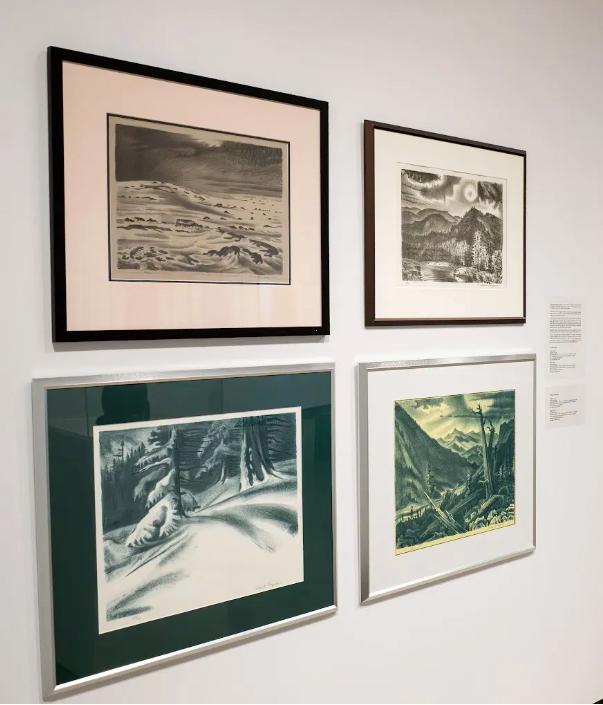
Top left to right: 1996.004.037, Frederick Hagan , EXPLORATION, ed. 26 / 44 -- Discoverers – Valley West, 1989. Stone lithograph on St. Armand paper (handmade in Quebec). Brock University Art Collection , Donated by artist, 1996.
1996.004.040, Frederick Hagan , EXPLORATION, ed. 28 / 44 – Discoverers, Quiet Land, 1989. Stone Lithograph on St. Armand paper (handmade in Quebec). Brock University Art Collection , Donated by artist, 1996.
Bottom left – right: 1996.004.025, Frederick Hagan, EXPLORATION, ed. 26 / 44 -- Investigators -- Drifting Snow, 1989. Stone Lithograph on St. Armand paper (handmade in Quebec). Brock University Art Collection , Donated by artist, 1996 .
1996.004.004 , Frederick Hagan , EXPLORATION, ed. 26 / 44 -- Discoverers -- Wooded Hills, 1989. Stone Lithograph on St. Armand paper (handmade in Quebec). Brock University Art Collection, Donated by artist, 1996 .
Frederick Hagan (1918 – 2003) was born in Toronto in 1918 and raised in Cabbagetown where, in his early years, he looked to his lived environments as sources for his artistic subjects.
In the latter part of Hagans creative career, the north became Frederick Hagan’s anchor, and often the work accomplished there became the source material for his paintings and prints.
In 1967, Hagan was awarded the Canadian Centennial Medal. In 1985, he was commissioned by Canada Post to create 16 postage stamps, issued 1986-1989. In 1998, he was awarded the Royal Canadian Academy of Arts Medal. His work is presented in prominent public collections including those of the Brock University Art Collection, the Art Gallery of Ontario, the National Gallery of Canada, and the Royal Ontario Museum.
Frederick Hagan’s printing press and lithograph stones, gifted by his family, are still in production and are located at Nipissing University in North Bay.
The four Frederick Hagan lithographs installed in Intentional Futures, are from the Exploration Suite, consisting of 55 lithographs that the artist donated to the Brock University Art Collection in 1996. These works feature iconic scenes of the Canadian north, highlighting its wintery landscape and stark extremes with the graphic quality black and white stone lithography.
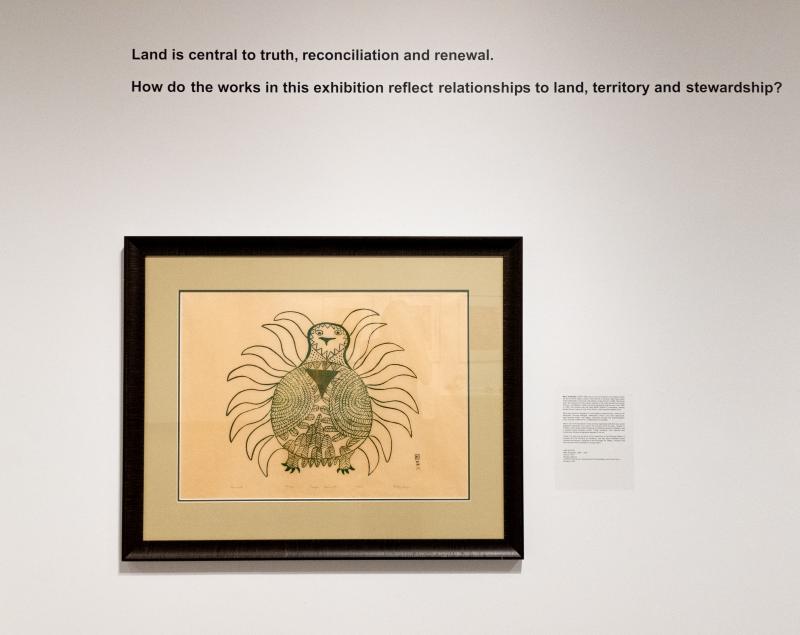
1987.001.074 , Mary Kudjuakju, 1908 – 1982 , Kumuk, 1973. Stonecut Stencil. A Gift from the Brock University Alumni, Association and a Grant from Wintario, 1978 .
Mary Kudjuakju (1908–1982) was an Inuit printmaker and midwife whose life and art were deeply rooted in the rhythms of the land. After many years living traditionally on the land, she settled in Cape Dorset in 1966. That same year, she became the first woman elected to the Cape Dorset Community Council—a trailblazer in both community leadership and the arts. From 1966 to 1982, she worked with the West Baffin Eskimo Co-operative, helping shape the early years of one of the North’s most important artistic hubs.
Mary was married to Kopapik "A" and raised a creative family—three of her daughters, Qaunaq Mikkigak, Sheokjuke Toonoo, and Laisa Qayuaryuk, also became artists. Her legacy continued through her granddaughter, Ovilu Tunnillie (1949–2014), a celebrated Inuit sculptor.
Mary’s own work focused on Arctic animals, especially birds like owls, which appeared frequently in her prints. Her stonecut prints of owls—"ookpik" in Inuktitut—carry deep cultural meaning, symbolizing wisdom, protection, and a spiritual guide between worlds. These creatures, both watchful and mysterious, became a signature element in her art.
Today, her work can be found in the collections of the National Gallery of Canada and the Portland Art Museum, and has been exhibited across Canada and beyond, including at the Winnipeg Art Gallery, Feheley Fine Arts, and the Frye Art Museum, among others.
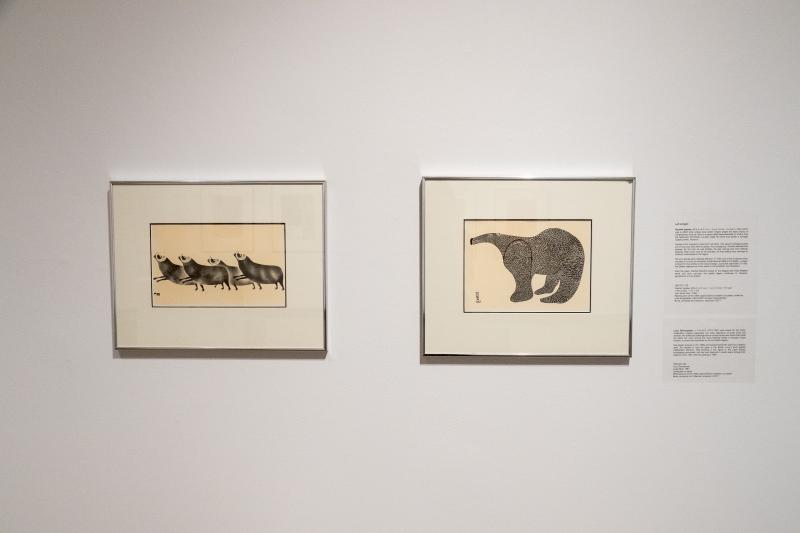
Left to right: 1987.001.130 , Osuitok Ipeelee, RCA ᐅᓱᐃᑐ ᐃᐱᓕ, Cape Dorset / Kinngait (1923-2005) — E7-1154 , Four Musk Oxen, 1959. Reproduction of the 1959 original Stencil (sealskin) on paper, printed by Iyola Kingwatsiak (1933-2000) Kinngait (Cape Dorset). Brock University Art Collection, acquired in 2017 .
1987.001.074 , Mary Kudjuakju, 1908 – 1982 , Kumuk, 1973. Stonecut Stencil . A Gift from the Brock University Alumni, Association and a Grant from Wintario, 1978 .
Osuitok Ipeelee, RCA ᐅᓱᐃᑐ ᐃᐱᓕ, Cape Dorset / Kinngait (1923-2005) was a gifted artist whose long career helped shape the early history of contemporary Inuit art. Born in a camp called Neeouleeutalik (in what is now the Northwest Territories), he later made his home and career in Kinngait (Cape Dorset), Nunavut.
Osuitok's first inspiration came from his father, who carved cribbage boards out of ivory and sold them to sailors. As a young boy, Osuitok watched and learned. By the time he was thirteen, he was carving toys from leftover shipping crate wood, and by his twenties, he was selling ivory carvings to Catholic missionaries in the region.
His work gained early national attention. In 1952, four of his sculptures were included in Inuit Art, an exhibition at the National Gallery of Canada—a major moment for Inuit artists on the national stage. Just a few years later, in 1955, the Gallery featured six of his works in the exhibition Inuit Sculpture.
Over the years, Osuitok became known for his elegant and finely detailed stone and ivory carvings. His artistic legacy continues to influence generations of Inuit artists.
Lucy Qinnuayuak ᓗᓯ ᑭᓐᐅᐊᔪᐊ (1915-1982) was known for her joyful, imaginative images—especially her lively depictions of arctic birds and animals. Her prints and drawings have a unique rhythm and charm that made her stand out, even among the many talented artists in Kinngait (Cape Dorset), a community renowned for its rich artistic legacy.
She began drawing in the 1950s and quickly found her voice as a graphic artist. As interest in Inuit art grew in the South, Lucy’s work gained widespread attention. She became a key figure in the Cape Dorset printmaking movement, with her work featured in nearly every annual print collection from 1961 until her passing in 1982.
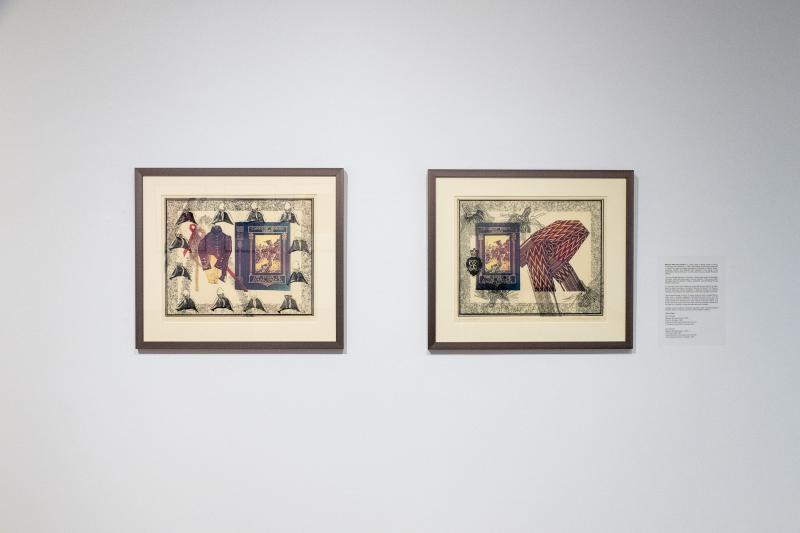
Left to right : 2001.003.002, Merijean Morrisey-Clayton (1943 - ), A Hat for Sir Isaac, 1985. Coloured etching, zinc etched with nitric acid. Commissioned by Brock University, 1985.
2001.003.001, Merijean Morrisey-Clayton (1943 - ),Tecumseh’s Gift, 1985. Coloured etching, zinc etched with nitric acid. Commissioned by Brock University, 1985.
Aqjangajuk Shaa (1937 – 2019) R.C.A. ᐊᔭᒐᔪ ᓴᐊ was known for his playful and powerful carvings of dancing animals, particularly the walrus. His earlier sculptures were rooted in the world of spirits, shamans, and traditional camp life.
He first picked up carving tools in the mid-1950s, encouraged by James Houston, a pivotal figure in bringing Inuit art to a wider audience. Over the next six decades, Axangayuk went on to create some of the most admired and sought-after sculptures of his generation.
Carving came naturally to him. He was deeply committed to working in the round—sculpting pieces that came alive from every angle, shaped by volume, space, and texture. He often let the shape of the stone guide him, and while he avoided fussy detail, his work always radiated movement and emotion.
Though he was regularly invited to try drawing or printmaking, Axangayuk always preferred the physical act of carving stone. That said, he did produce one remarkable print: Wounded Caribou, a 1961 stone cut that became one of the most successful images in the history of the Cape Dorset Annual Print Collection. Decades later, in 2018, he revisited that iconic image, contributing one of the year’s standout prints, along with a striking group of original drawings and etchings.
Axangayuk kept carving almost right up until the end of his life—testament to both his strong spirit and his deep love for the work
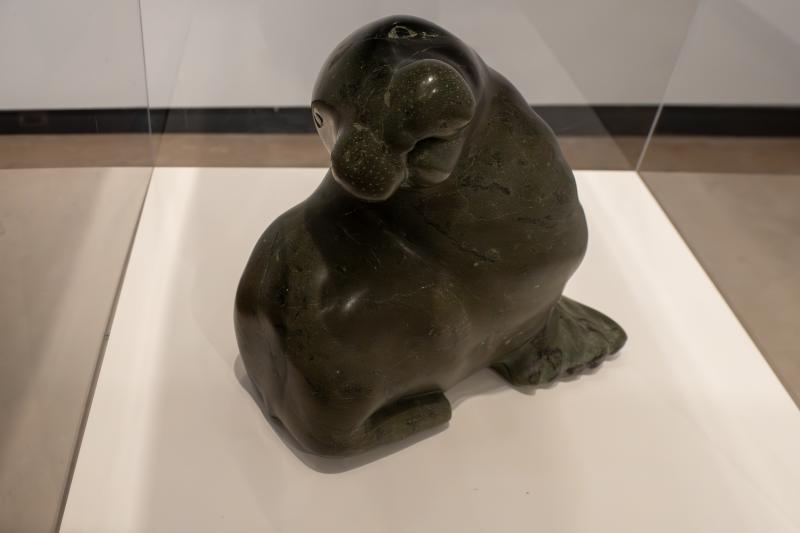
1987.001.010, Axangayuk Shaa 1937–2019, Kinngait Cape Dorset, Walrus. Soapstone. Brock University Art Collection, Gift of Brock University Alumni Assoc. and a Grant from Wintario, 1979.
Axangayuk Shaa (1937 – 2019) was one of Cape Dorset’s most celebrated artists, especially known for his playful and powerful carvings—dancing animals were a favourite, particularly the walrus. But if you look back at his earlier work, you’ll see something different: sculptures rooted in the world of spirits, shamans, and traditional camp life.
He first picked up carving tools in the mid-1950s, encouraged by James Houston, a pivotal figure in bringing Inuit art to a wider audience. Over the next six decades, Axangayuk went on to create some of the most admired and sought-after sculptures of his generation.
Carving came naturally to him. He was deeply committed to working in the round—sculpting pieces that came alive from every angle, shaped by volume, space, and texture. He often let the shape of the stone guide him, and while he avoided fussy detail, his work always radiated movement and emotion.
Though he was regularly invited to try drawing or printmaking, Axangayuk always preferred the physical act of carving stone. That said, he did produce one remarkable print: Wounded Caribou, a 1961 stone cut that became one of the most successful images in the history of the Cape Dorset Annual Print Collection. Decades later, in 2018, he revisited that iconic image, contributing one of the year’s standout prints, along with a striking group of original drawings and etchings.
Axangayuk kept carving almost right up until the end of his life—testament to both his strong spirit and his deep love for the work
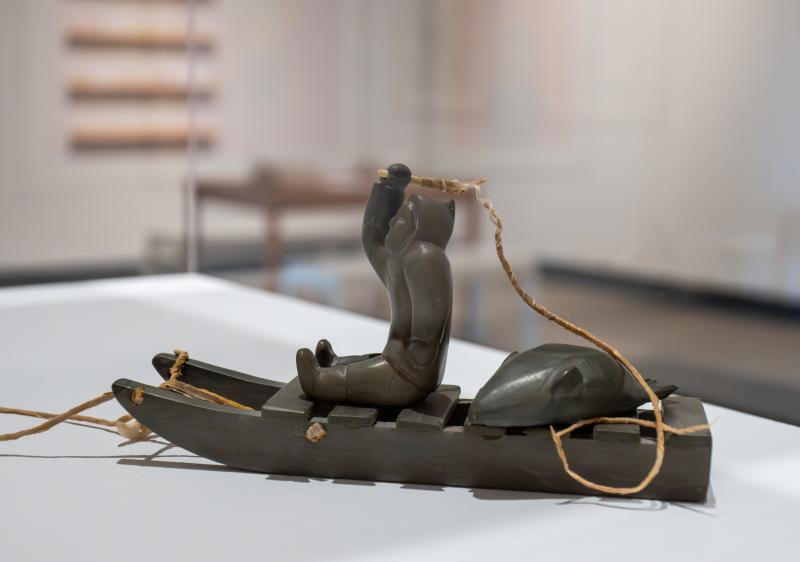
Unknown Inuit artist, Dog Team with Sled (Detail 01), c. 1950. Green serpentine soapstone. The Brock University Art Collection.
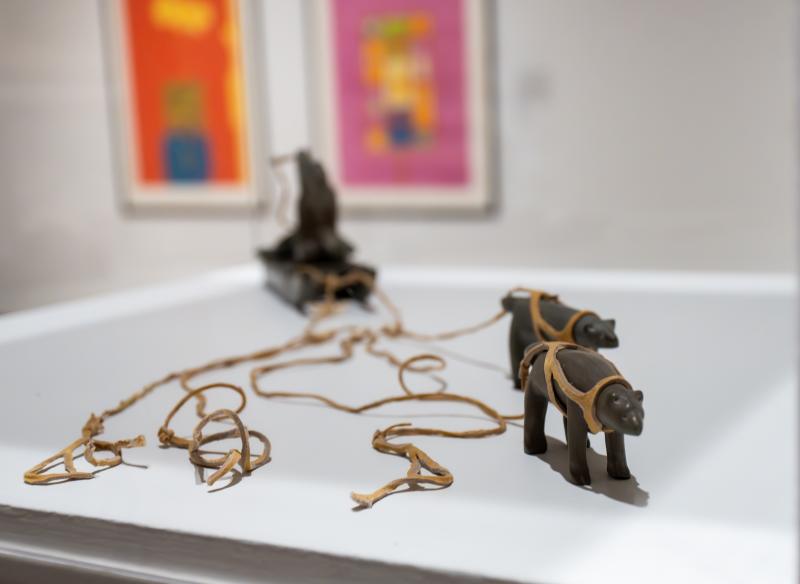
Unknown Inuit artist, Dog Team with Sled (Detail 02), c. 1950. Green serpentine soapstone. The Brock University Art Collection.
(Unknown Inuit Artist) Carved from green serpentine soapstone, a stone quarried in South Baffin Island, Nunavut – especially around Kinngait (Cape Dorset) and Iqaluit (Markham Bay). These quarries have supplied carvers in Kinngait since the mid-20th century.
This sculpture depicts a traditional dog team pulling a sled. Delicately carved in miniature, this sensitive rendering pays homage to the fact that dog sledding was and is still central to Inuit life, essential for hunting, travel, and survival across snow and sea ice.
Although incomplete—two of the dogs are now missing, the carving still conveys the team's strength and unity. Carved from green serpentine soapstone, this sculpture depicts a traditional dog team pulling a sled: its soft green colour is often associated with vitality and renewal. At the same time, the stone itself reflects endurance and resilience. In the hands of Inuit carvers, soapstone becomes both a practical material and a symbolic link between people, animals, and the Arctic landscape.
Soapstone carvings such as this one not only document everyday activities, but they also carry symbolic meaning, expressing endurance, cooperation, and the close relationship between Inuit people and their animals.
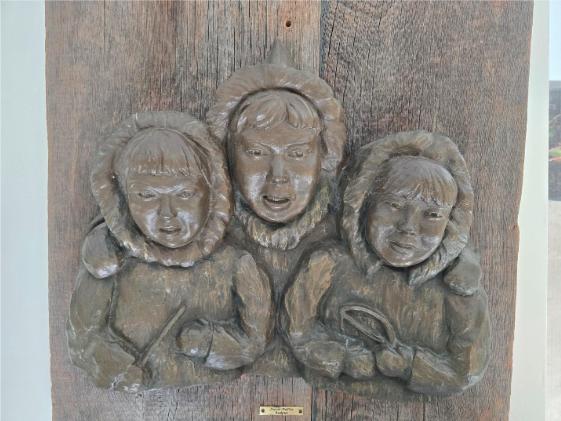
Harold Pfeiffer, Three Inuit Children (originally titled Three Eskimo Children), c. 1960 . Bronze resin bas-relief. The Brock University Art Collection .
This work by Harold Pfeiffer (1922–1997), a white settler artist who spent time in the North, portrays three Inuit children in a simplified, idealized form. Created in the 1960s, the sculpture reflects both the era’s interest in representing Inuit life and the limitations of those depictions. Today, this piece raises questions about representation: Whose voice is being heard? Who has the authority to speak on behalf of another community? Seen through this lens, the work is both an artifact of its time and a prompt for reflection on how Inuit stories are told, by whom, and for what purpose.
About the Title
When this artwork was first created, the term “Eskimo” was commonly used by non-Indigenous people to describe Inuit. Today, this word is understood as offensive because it was imposed from outside the community and has often been used in harmful or inaccurate ways. We have changed the title to use “Inuit,” the name the people use for themselves. This update reminds us that language matters, and that being inclusive means listening to communities, respecting how they identify, and being open to revising the words we inherit from the past.
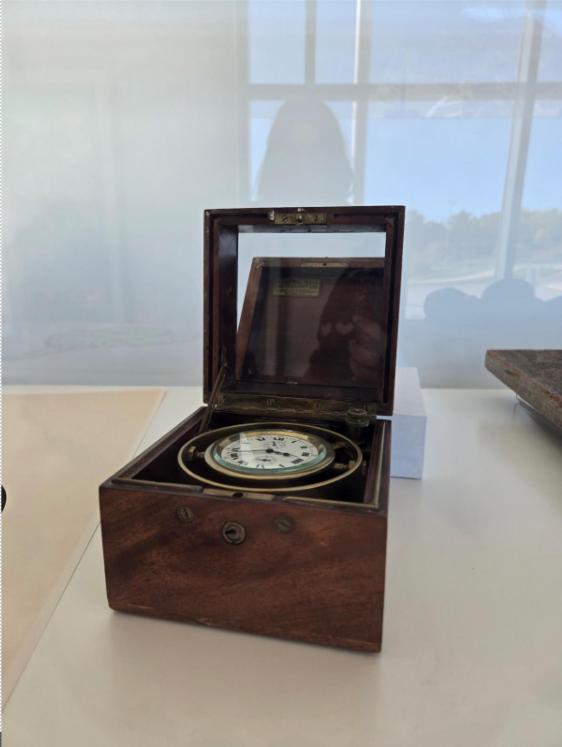
1990.002.010, Elgin Model 600 Marine Chronometer (Detail 01), circa 1844 – 1860. Brass, glass, and wood. The Brock University Art Collection .
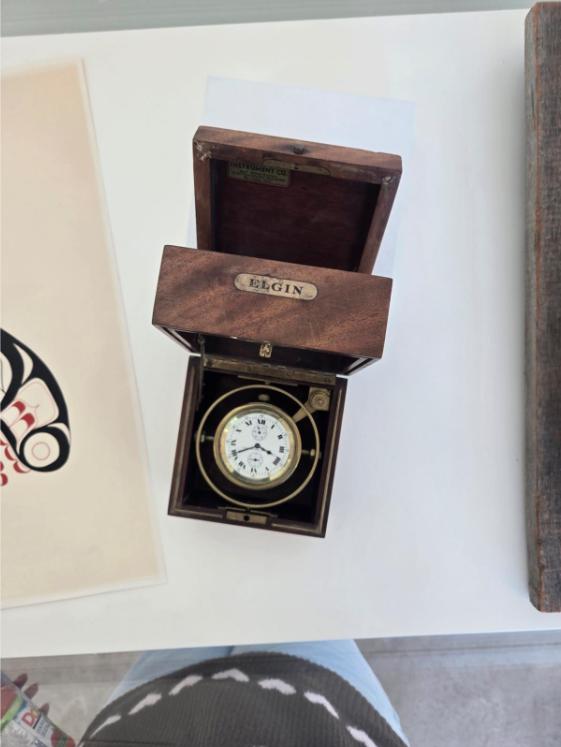
1990.002.010, Elgin Model 600 Marine Chronometer (Detail 02), circa 1844 – 1860. Brass, glass, and wood. The Brock University Art Collection .
This precision timepiece, crafted by the Elgin National Watch Company, was used during late 19th-century expeditions in Nunavut. Chronometers were essential tools used during colonial exploration and navigation.
This navigational tool was made by the Elgin National Watch Company beginning in World War II. Approximately 250 units were manufactured and sold to the public, making them rare and highly prized among collectors today.
These chronometers were designed for precise timekeeping on naval ships, featuring a two-day power reserve and housed in a gimbaled brass bowl with a mahogany case. By keeping highly accurate time, they allowed explorers to calculate longitude and chart unfamiliar waters.
Carried into the Arctic aboard exploration vessels, instruments like this one reflect the era’s drive for mapping and claiming northern territories. At the same time, they stand as reminders of the colonial frameworks through which such journeys were undertaken, and intentionally usurp Inuit knowledge of land, sea, and sky.
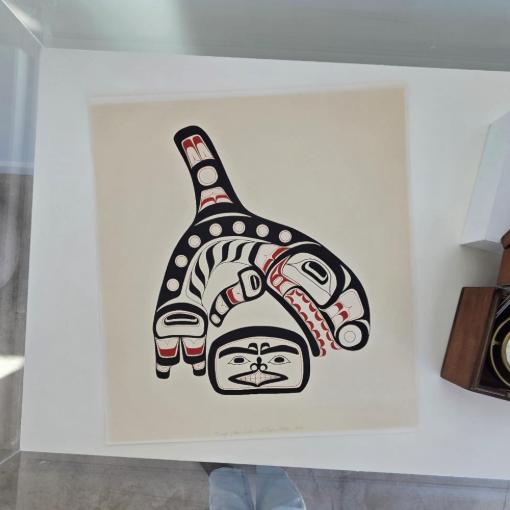
Unknown Tlingit Artist, Killer Whale and Rock Sitter, 1859. Screenprint. The Brock University Art Collection.
(Unknown Tlingit Artist) Created in the mid-19th century, this bold and dynamic screenprint reflects both artistic mastery and cultural resilience during a period of profound upheaval brought by colonial expansion, trade, and missionary activity.
The killer whale (keet), featured in this work, is among the most powerful beings in Tlingit cosmology. Revered as a clan crest and spiritual ancestor, the whale embodies strength, kinship, and the close ties between land, sea, and human communities. The figure below—sometimes referred to as a “rock sitter”—is believed to represent a human or spiritual presence that mediates between realms, echoing oral traditions in which animals and people could transform and communicate with one another.
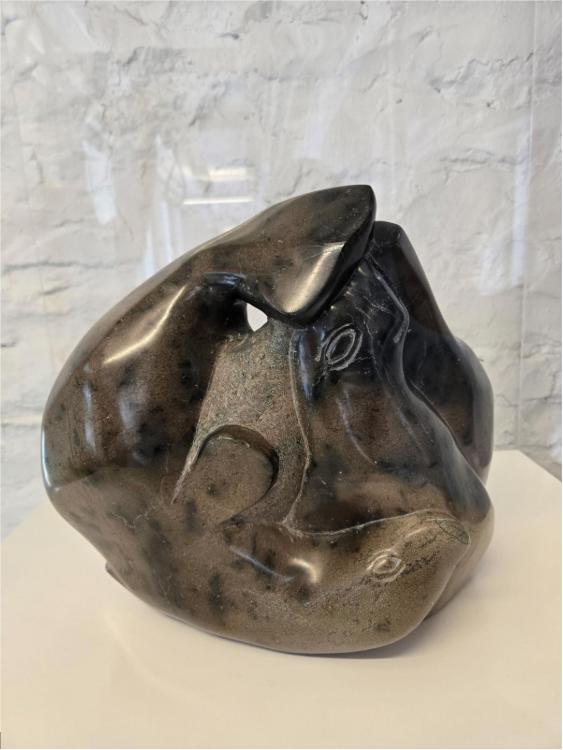
Unknown Inuit Artist, Three Entwined Seals, c. 1960. Black soapstone. The Brock University Art Collection.
(Unknown Inuit Artist) Carved from deep black Arctic stone, this sculpture shows three seals closely intertwined, their forms merging in fluid, circular movement. Seals are central to Inuit life, valued for food, clothing, and fuel, and they often appear in Inuit art as symbols of abundance and survival. The artist, though unknown, captures the character of the animals and the smooth striated qualities of the stone itself.
Black soapstone, often found in argillite or some serpentine varieties, frequently symbolized the depths of the ocean, the night sky, or the spiritual realm. Carvings from this rich deposit depict people, animals, spirits, and scenes of hunting or family life. The stone itself carries meaning: black suggests depth, endurance, and spiritual presence. The act of fine carving transforms the raw material into a lasting expression of Arctic culture and imagination.