René Gasnier
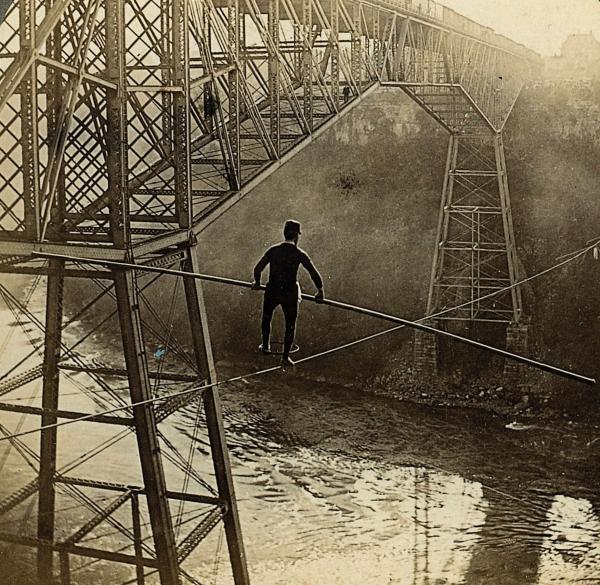
Reading travellers’ accounts of their visits to Niagara Falls is a fascinating occupation, not just because there exists an abundance of them, but also because they disclose a broad spectrum of reactions. Depending on individual inclination and the aesthetics prevalent at the time of their writing, they may express wonder and awe, as well as boredom or a feeling of peacefulness. Their descriptions may exaggerate the characteristics of the scenery or be as detailed – or as sensory – as possible. Comments on the sublime natural elements are often associated with remarks on amenities available to travellers from small-scale to today’s consumerist tourism and/or on the impressive industrial infrastructure that has transformed the Falls over the centuries and made the once pristine landscape into a geographical landmark marketed around the globe.
René Gasnier’s account in his “Villes américaines: notes d’un aéronaute de la coupe Gordon Bennett aux Etats-Unis (octobre, novembre, décembre 1907)” is that of a Frenchman who is passionate and knowledgeable about engineering. He rides a steam tricycle, travels on sailboats, flies hot-air balloons, and builds small airplanes. A pioneer, he successfully completes his first flight in 1908, covering a distance of approximately 1,500 metres. In comparison, the Wright brothers’ first powered flight occurs in 1903; it lasts 12 seconds and travels about 36 metres.
The purpose of Gasnier’s 1907 trip to North America is first and foremost to participate in the Gordon Bennett Cup, a gas balloon race. It is also for him the occasion to go on a sightseeing tour.
His journal entry on his visit to Niagara Falls is remarkable on three grounds. Although it is written by a young man with a keen interest in mechanics and adventurous projects, it reads nicely as a praise to a physical activity that does not require any engineering feat or competitive spirit: leisure walking. Nevertheless, it also offers the point of view of someone who is aware of and appreciates the industrial innovations shaping the Falls – the exploitation of hydroelectric power and the waterworks. Finally, it is sensitive to efforts made to protect the scenic environment. Frederick Law Olmsted and James T. Gardner’s “Special Report on the preservation of Niagara Falls,” submitted to the New York State legislature in 1879, defined what could be considered as an expertly calculated landscape, attractive to both industrialists and nature lovers. About thirty years later, Gasnier notes the importance of such endeavours.
Resulting from a cooperation between the Research Centre in Interdisciplinary Arts and Creative Culture (Centre for Studies in Arts and Culture, STAC) and Brock’s Archives and Special Collections, Walking with an Aeronaut offers the translation into English of René Gasnier’s account of his visit to Niagara in his 1907 French-language travel journal. The original manuscript is located in Brock’s Archives and Special Collections. Walking with an Aeronaut also features three original drawings by contemporary St. Catharines artist Geoff Farnsworth as well as archival photos of the Falls from the time of Gasnier’s visit.
Curator: Catherine Parayre / Translator: Nicholas Hauck / Drawings: Geoff Farnsworth
Bibliographical references:
Cameron, Chantal. “René Gasnier Travel Journal, 1907”. Archives and Special Collections, Brock University. https://hdl.handle.net/10464/19390
Gasnier, René. "Crossing the Atlantic" (1-5) and "Niagara Falls" (40-47). In: “Villes américaines: notes d’un aéronaute de la coupe Gordon Bennett aux Etats-Unis (octobre, novembre, décembre 1907).” Archives and Special Collections, Brock University. RG931: https://hdl.handle.net/10464/19458
Knight, Derek, curator. Industrial Niagara. St. Catharines, ON: Small Walker Press, 2021.
Uri, John. “120 Years Ago: The First Powered Flight at Kitty Hawk.” NASA Johnson Space Centre. 2023. Online.