A calculated landscape
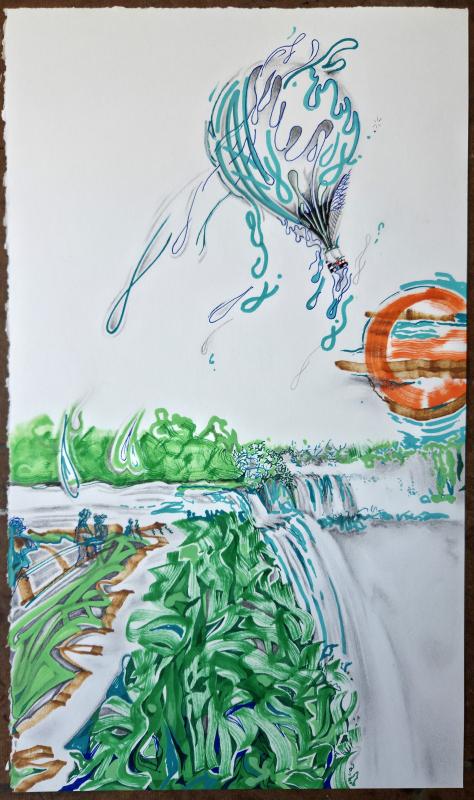
René Gasnier, "Niagara Falls"
Among my memories of Niagara, one of the best is a walk we took at dusk on the Canadian side. We walked up the left bank. The sound of the falls gradually diminished and the woods lining the road made it very dark. At a bend in the path, we saw a large, dimly lit building ahead of us and, as we advanced, we saw columns stand out and a vast palace take shape, with wide staircases leading down to the road. We climbed a few steps and the glow of electric lamps, softly filtered through frosted glass, revealed a French garden with neatly arranged flowerbeds stretching out on both sides. Among my memories of Niagara, one of the best is a walk we took at dusk on the Canadian side. We walked up the left bank. The sound of the falls gradually diminished and the woods lining the road made it very dark. At a bend in the path, we saw a large, dimly lit building ahead of us and, as we advanced, we saw columns stand out and a vast palace take shape, with wide staircases leading down to the road. We climbed a few steps and the glow of electric lamps, softly filtered through frosted glass, revealed a French garden with neatly arranged flowerbeds stretching out on both sides.
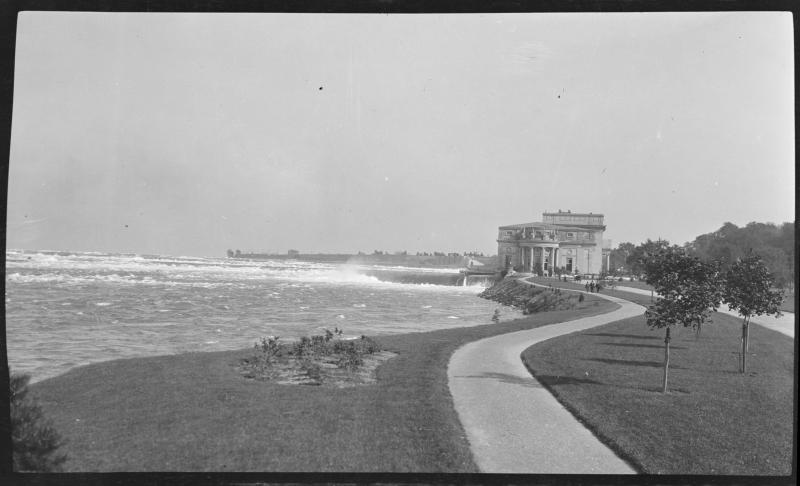
After a few more steps, we passed through the stone columns, walked on marble paving, and glancing through large windows, discovered an immense white room covered with mosaics and a very high ceiling supported by more columns. Silence reigned, and only a few lamps illuminated the barren space. Listening closely, we could hear a slight constant humming. Here and there, a steel turret about two meters high emerged from the floor, and a few men, whom we had not noticed at first, seemed to be meditating or dozing in armchairs. From time to time, one of them got up, approached one of the steel turrets, attentively observed something mysterious, made a gesture or two, then went back to sit down. I didn’t know whether to continue my visit or leave that place with the impression that I had strayed into the forest and arrived at a fairy palace. The enormous, silent, almost deserted dwelling, lit by strange lights, seemed more unknown, more legendary than the fantastic residences in Perrault’s tales. But we are a culture of knowledge and information, and the extraordinary no longer moves us; today there is nothing impossible nor incredible. The magical, tranquil palace concealed an active and colossal force; within its walls roared the power of two hundred thousand horses.
New laws requiring respect for the landscape lend a brilliant and mysterious appearance to what would otherwise have been a simple iron and brick factory. The spell was broken; we were able to enter and consider things from a more enlightened point of view. An elevator took us 50 meters below ground. This is where the turbines turn, driving the dynamos enclosed in the steel domes of the great hall. Here, the noise became intense; the pressure caused water droplets to spurt from the joints of the giant pipes, which cannot be made completely watertight. The first time water entered the pipes, whose strength was not properly calculated, they burst under the pressure of the liquid and killed several workers. The principle governing these turbines is quite different from what we saw in the other factory in the morning. We learned that old Europe still has its strengths, because the first machine we admired was built in Zurich. What is truly prodigious and exists nowhere else is the enormous amount of force accumulated in one place, whose motion is controlled and directed by a small number of workers. The electric currents are so powerful that it would be impossible to manually operate the switches for the different lines. They are controlled electronically by means of small levers arranged on a single panel. The currents travel up to 200 kilometers away to light cities, deliver electricity to factories, and power trams.
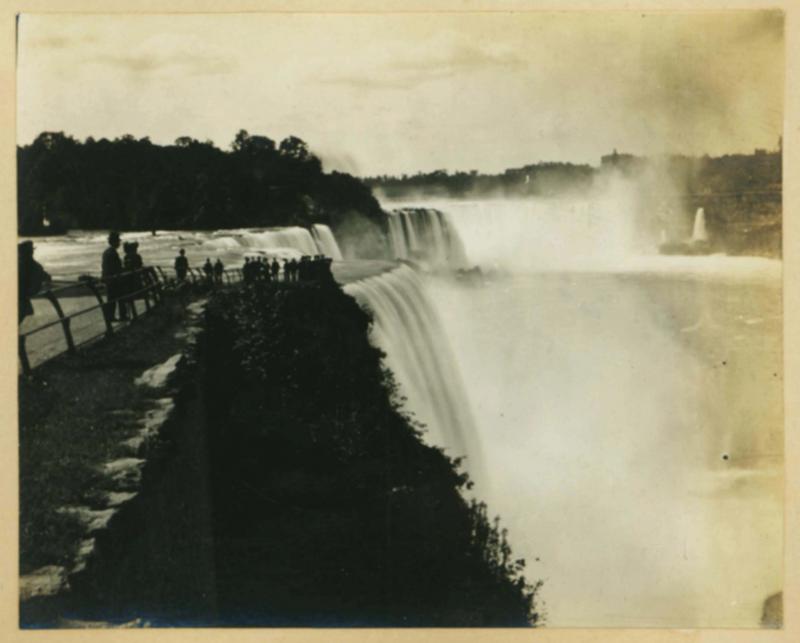
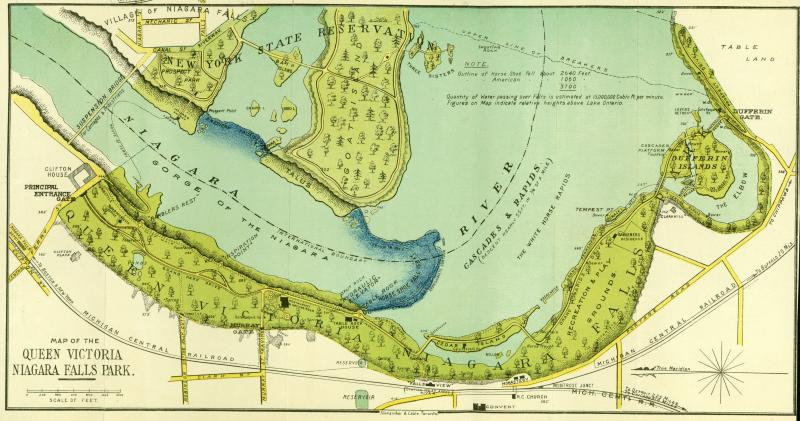
There is a classic walk to take in Niagara that is rarely mentioned, as visitors are mesmerized by the falls. This walk consists of going down the left bank and returning on the American side. Along the way, one can see a series of remarkable rapids stretching for about 20 kilometers. The current is so strong in some places that the water recedes from the banks and rises to form a kind of dome between the two sides of the river. Everyone knows about the various attempts to go down Niagara Falls by boat and how some daredevils fell victim to this foolish feat, while others succeeded by throwing themselves from the top of the falls in closed barrels.