La Fin de Siècle and the Pull of Opposite
Item
Title
La Fin de Siècle and the Pull of Opposite
Description
This is an article written by Kathleen Gallagher on Belle Moral. Gallagher discusses the different pull of opposites at work in the play, such as science vs nature, truth and lies, normal and deviant, and rational vs supernatural. She also discusses Scotland being historically a place in which such contradictions occur. Gallagher discusses the Victorian ideals of femininity and various theories, which have influenced the play, such as those of Sigmund Freud.
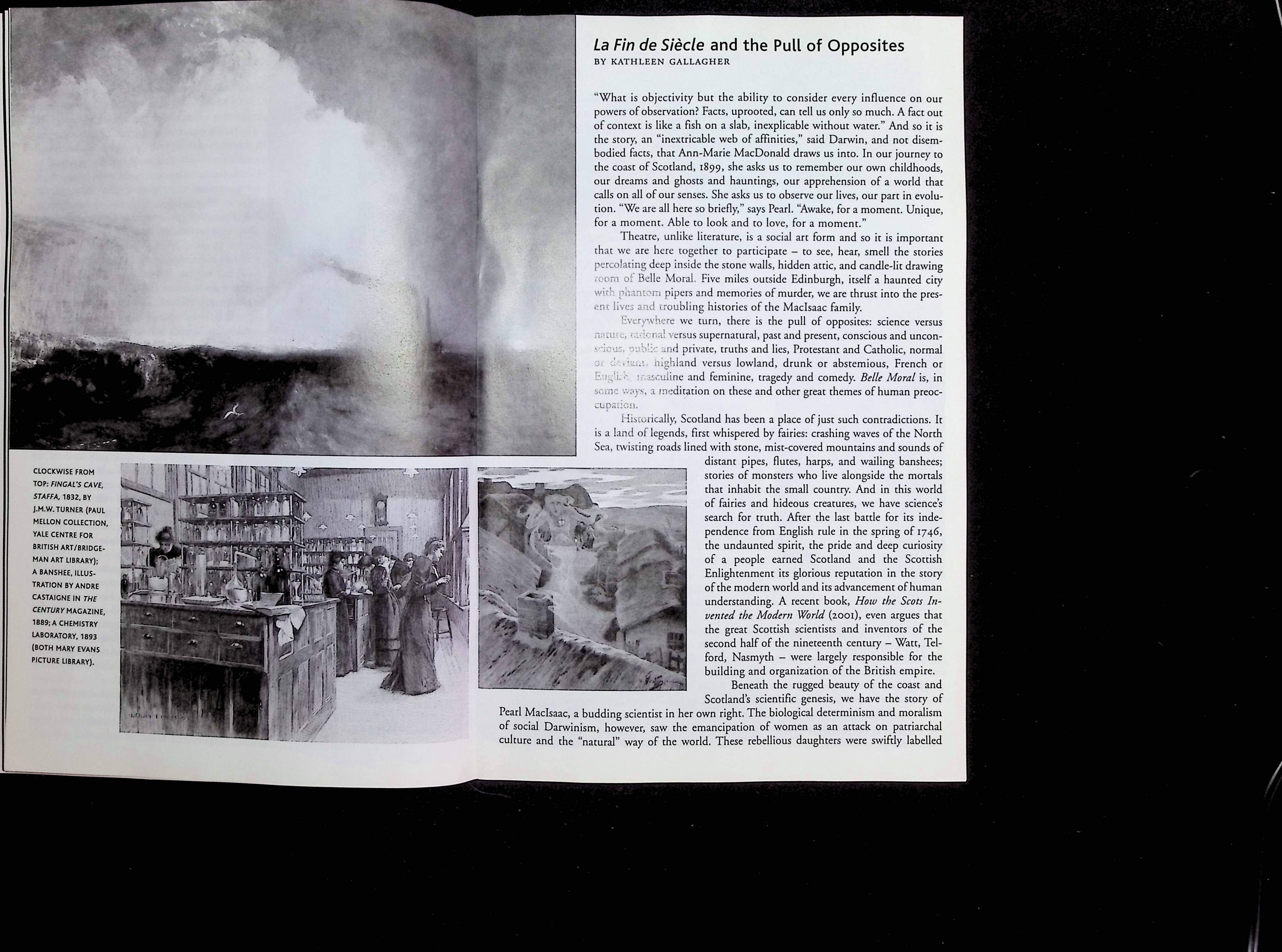
The first page of this article features 3 photos. Clockwise from the top of the page, these photos are:
- Fingal's Cave, Staffa, 1832, by J.M.W. Turner (Paul Mellon Collection, Yale Centre for British art/Bridgeman Art Library)
- A Banshee, illustration by Andre Castaigne in The Century Magazine, 1889
- A chemistry laboratory, 1893 (Mary Evans Picture Library)
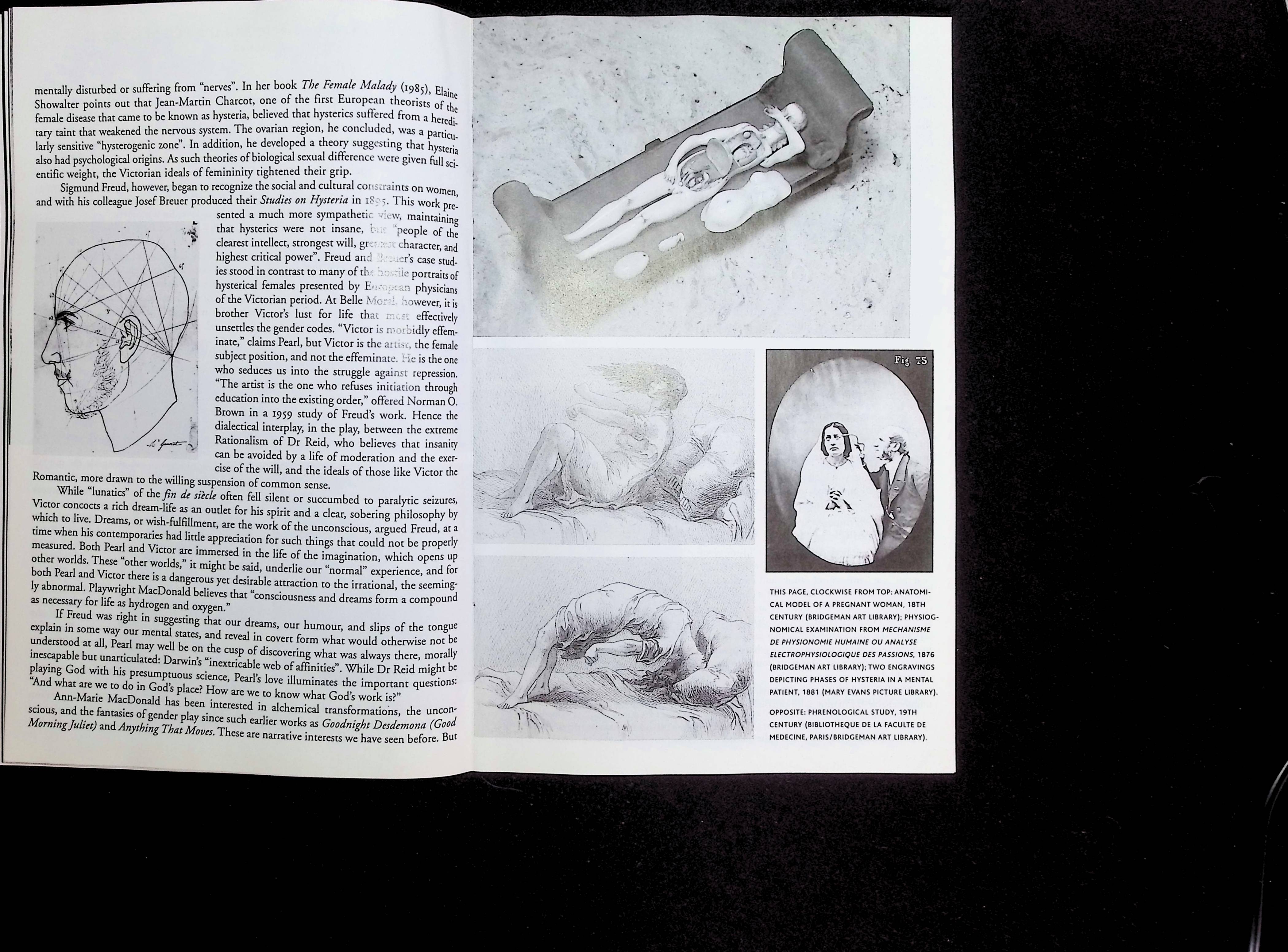
The second page of this article features 5 photos. Clockwise from the top of the page, these photos are:
- Anatomical model of a pregnant woman, 18th century (Bridgeman Art Library)
- Physiognomical examination from Mechanisme de Physionmie Humanie ou Analyse Electrophysiologique des Passions, 1876 (Bridgeman Art Library)
- Two engravings depicting phases of hysteria in a mental patient, 1881 (Mary Evans Picture Library)
- Phrenological study, 19th century (Bibliotheque de la Faculte de Medecine, Paris/Bridgeman Art Library)
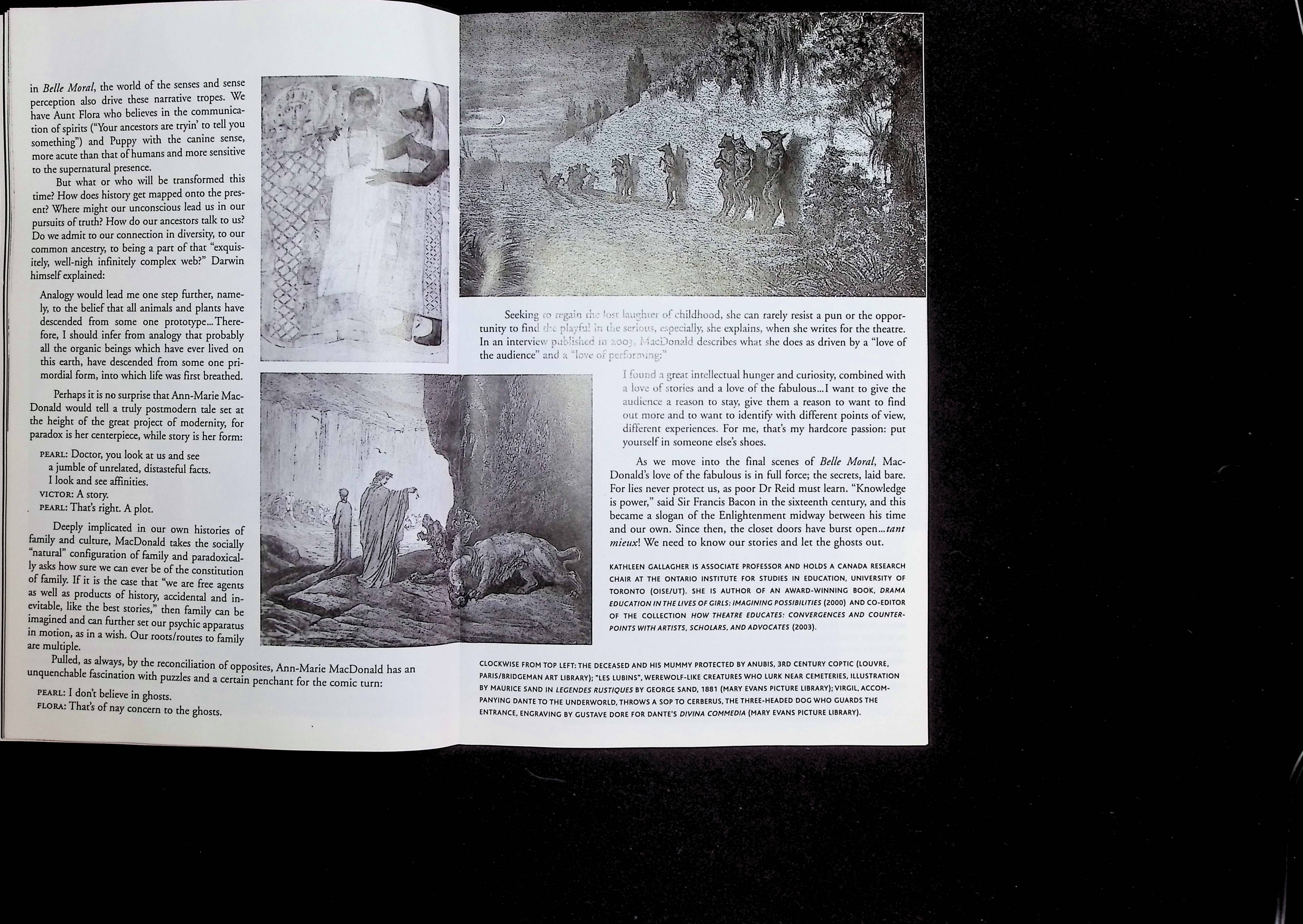
The third page of this article features 3 photos. Clockwise from the top left of the page, these photos are:
- The deceased and his mummy protected by Anubis, 3rd century coptic (Louvre, Paris/Bridgeman Art Library)
- "Les Lubins," werewold-like creatures who lurk new cemetaries, illustration by Maurice Sand in Legends Rustiques by George Sand, 1881 (Mary Evans Picture Library)
- Virgil, accompanying Dante to the underworld, throws a sop to Cerberus, the three-headed dog who guards the entrance, engraving by Gustave Dore for Dante's Divina Commedia (Mary Evans Picture Library)
The first page of this article features 3 photos. Clockwise from the top of the page, these photos are:
- Fingal's Cave, Staffa, 1832, by J.M.W. Turner (Paul Mellon Collection, Yale Centre for British art/Bridgeman Art Library)
- A Banshee, illustration by Andre Castaigne in The Century Magazine, 1889
- A chemistry laboratory, 1893 (Mary Evans Picture Library)
The second page of this article features 5 photos. Clockwise from the top of the page, these photos are:
- Anatomical model of a pregnant woman, 18th century (Bridgeman Art Library)
- Physiognomical examination from Mechanisme de Physionmie Humanie ou Analyse Electrophysiologique des Passions, 1876 (Bridgeman Art Library)
- Two engravings depicting phases of hysteria in a mental patient, 1881 (Mary Evans Picture Library)
- Phrenological study, 19th century (Bibliotheque de la Faculte de Medecine, Paris/Bridgeman Art Library)
The third page of this article features 3 photos. Clockwise from the top left of the page, these photos are:
- The deceased and his mummy protected by Anubis, 3rd century coptic (Louvre, Paris/Bridgeman Art Library)
- "Les Lubins," werewold-like creatures who lurk new cemetaries, illustration by Maurice Sand in Legends Rustiques by George Sand, 1881 (Mary Evans Picture Library)
- Virgil, accompanying Dante to the underworld, throws a sop to Cerberus, the three-headed dog who guards the entrance, engraving by Gustave Dore for Dante's Divina Commedia (Mary Evans Picture Library)
Creator
Kathleen Gallagher
Date
2005
Subject
Arab's Mouth / Belle Moral
Source
From Ann-Marie MacDonald's personal archive