-

Description from Amazon: "The Donnelly Album By now everyone in Canada knows at least one version of the brutal slaying of members of the Donnelly family on the night of February 3, 1880. The Donnelly Album tells in compelling detail the story of the Donnellys-James and Johannah and their seven sons and one daughter. Arriving in Canada from Tipperary, Ireland, in the 1840s, the family settled in the boisterous Irish pioneer community in Biddulph Township near London, Ontario. For the next thirty years, their activities gained wide notoriety in the surrounding district. The father was once convicted of murder but escaped the gallows. The sons grew up to be handsome, reckless, enterprising in business, and dangerous in combat. Largely because of their presence, Lucan, the village nearest their farm home, became known as the widest town in Canada. What is it about the Donnellys that have fascinated so many people for many years? Were they really as wicked as their enemies have portrayed them? Why was no one ever convicted of the murders? What happened to the surviving Donnellys? Why do local people today still fell so strongly, both pro and con, about the family? After fifteen years of exhaustive research, Ray Fazakas has produced the definitive account of the famous feud and its tragic consequences. He has also collected an astonishing treasure trove of old photographs, contemporary drawings, maps, and documents of the Donnellys, their murderers, and the sites and people involved in the events. This unique combination of narrative and illustration recreates not just an epic tragedy but an entire segment of Canadian frontier life. Ray Fazakas is a well-known Hamilton lawyer."
-
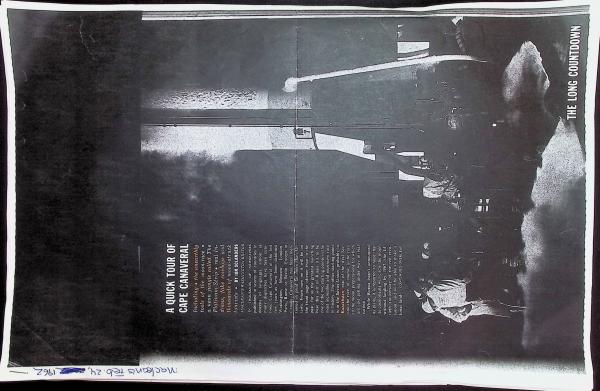
An article by Ian Sclanders from Maclean's magazine, detailing why Cape Canaveral was the United States' choice to be their primary rocket launch center during the space race, and the effects the rocket launches had on the surrounding area. The first page shows a photo of the bottom half of a rocket with several men standing at its base. This page also contains handwriting along its left side, reading, "Maclean's Feb. 24, 1962". The next two pages are adorned at the bottom with photos of people looking up and shielding their eyes with their hands, as if watching a rocket take off.
The reasons provided for why Cape Canaveral was chosen as the United States' primary rocket launch center are: 1. It is very flat, 2. It is remote and thinly populated, and 3. There is a 5,000 mile stretch of ocean from Canaveral to Ascension Island, acting as a perfect missile testing range with minimal risk should accidents occur. Many of those who lived nearby were given $60,000,000 to vacate the area and deed the government an additional 72,000 acres. This land would be used for, "six moon-rocket launching complexes that 4,300 workers will construct at a cost of $700,000,000 over the next three or four years, and also for a buffer zone to isolate the mighty explosive force and the ear-shattering din of the coming moon shots, which will have a thrust of 12,000,000 or more pounds each."
The article also notes how there are tracking stations that track the missiles launched at Canaveral. They are located on "Grand Bahama Island, San Salvador, Mayaguana, Grand Turk, Hispaniola, Puerto Rico, Antigua, St. Lucia, Fernando de Noronha and Ascension Island." The stations were operated by Pan-American World Airways, but were each under the command of a U.S. Air Force officer with RCA (Radio Corporation of America) recording the signals from the rockets.
Brevard County soon became the quickest growing county in the U.S., with surrounding cities like Cocoa Beach growing rapidly because of the rocket launch center. Cocoa Beach went from having around four-hundred residents to six thousand, quickly becoming home to thirty motels and twenty restaurants, and adopting the moniker, "Platinum Strip." Real estate prices in Cocoa Beach tripled during the fifties and sixties, with similar increases occurring in other towns and cities near Canaveral as well.
-

Description from Thriftbooks: "It is rare in history for people to link their identity with their generation, and even rarer when children and adolescents actually shape society and influence politics. Both phenomena aptly describe the generation born in the decade following the Second World War. These were the baby boomers, viewed by some as the spoiled, selfish generation that had it all, and by others as a shock wave that made love and peace into tangible ideals. In this book, Doug Owram brings us the untold story of this famous generation as it played out its first twenty-five years in Canadian society.
Beginning with Dr Spock's dictate that this particular crop of babies must be treated gently, Owram explores the myth and history surrounding this group, from its beginning at war's end to the close of the 1960s. The baby boomers wielded extraordinary power right from birth, Owram points out, and laid their claim on history while still in diapers. He sees the generation's power and sense of self stemming from three factors: its size, its affluent circumstance, and its connection with the 1960s - the fabulous decade of free love, flower power, women's liberation, drugs, protest marches, and rock 'n' roll. From Davy Crockett hats and Barbie dolls to the civil-rights movement and the sexual revolution, the concerns of this single generation became predominant themes for all of society. Thus, Owram's history of the baby-boomers is in many ways a history of the era.
Doug Owram has written extensively on cultural icons, Utopian hopes, and the gap between realities and images - all powerful themes in the story of this idealistic generation. A well-researched, lucid, and humorous book, Born at the Right Time is the first Canadian history of the baby-boomers and the society they helped to shape."
-

Unable to find a description of the text, which is only 16 pages in length. VPLbibliocommons has this within the "Subject and genre" section of their listing: "Canada.
Great Britain.
Constitutional amendments — Canada
Federal-provincial relations — Canada
Canada — Politics and government — 1980-1984
Canada — Politics and government — 1984-1993"
-
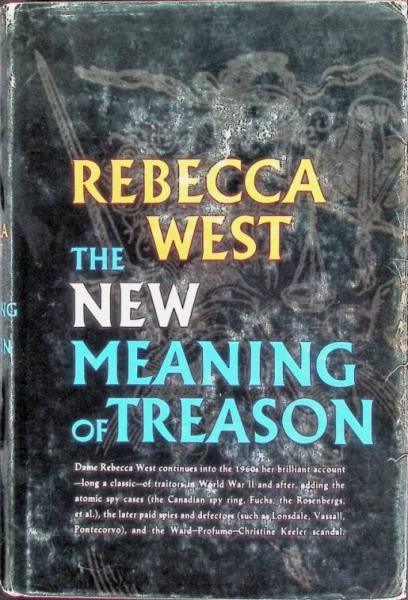
"Rebecca West tackles not only the history and facts behind the spate of World War II traitors, but the overriding social forces at work to challenge man’s connection to his fatherland. As West reveals in this expanded edition, the ideologically driven amateurs of World War II were followed by the much more sinister professional spies for whom the Cold War era proved a lucrative playground and put Western safety at risk. Filled with real-world intrigue and character studies, West’s narrative connects the war’s treasonous acts with the rise of Communist spy rings in England and tackles the ongoing issue of identity in a complex world." - Amazon
-

The cover of "Snow Job: Canada, the United States and Vietnam (1954-1973)" by Charles Taylor. The cover is mostly a dark blue, with the words "SNOW JOB:" in red. Superimposed on the words "SNOW JOB:" is an image of five Canadian men serving on the "International Commission of Control and Supervision" in Vietnam, identified by their berets and short-sleeved, white button-down uniform.
The synopsis of the book reads as follows, "Canada's twenty-year involvement with the U.S. in the Vietnam War is carefully and brilliantly analyzed in this controversial book."
-

The cover of "The CIA's Greatest Hits" by Mark Zepezauer, part of "The Real Story Series". The cover features a cartoon of a man in a trench coat, sunglasses, and fedora, carrying a briefcase and smoking a cigarette, while holding the Statue of Liberty at gunpoint. The Statue of Liberty is depicted as human-sized, and she has dropped her torch in fear. The colors featured most prominently on this cover are mustard yellow along the top, magenta on the bottom half, and black along the left side.
The synopsis of the book reads as follows, "In crisply written, two-page chapters, each accompanied by a cartoon, this book tells you how the CIA
hired top Nazi war criminals, shielded them from justice and learned (and used) their techniques
was involved in the massacre at Jonestown, the bombing of Pan AM flight 103, Watergate, Iran/Contra, the Bay of Pigs, rigged elections in Italy and drug trafficking in Afghanistan and across the globe
participated in the assassinations of John Kennedy, Robert Kennedy, Martin Luther King, many foreign politicians and literally million of ordinary people in Indonesia, East Timor, Central America, Vietnam and many other places
orchestrates the media - one CIA officer like to call it "the mighty Wurlitzer" - and places its agents inside newspapers, magazines and book publishers
and much, much more"
-
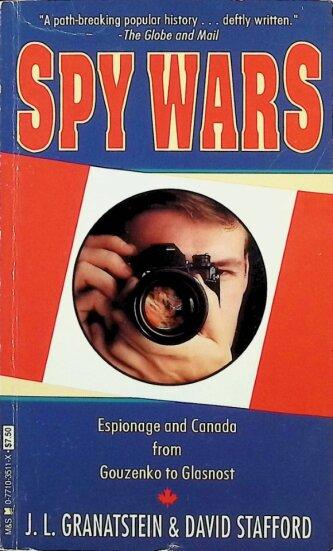
The cover of "Spy Wars: Espionage and Canada from Gouzenko to Glasnost" by J. L. Granatstein and David Stafford. The cover is mostly blue, and prominently features an image of the Canadian flag with the maple leaf replaced by a circular photograph of a closeup of a man holding a camera up to his eye. A review at the top of the cover by "The Globe and Mail" reads, "A path-breaking popular history... deftly written." The price of the book on its spine reads "$7.50".
The synopsis of the book reads as follows, "Fact as fascinating as fiction, this book delivers a briskly paced survey of Canada's secret history. To most Canadians, the world of espionage may seem a far off sort of affair, a great game played in often exotic locales by stealthy figures. But, as this pathbreaking book makes clear, Canada has been the site of considerable international intrigue, from Cold War skullduggery to high-tech terrorism. The authors argue that while the Cold War may be over, the spy wars will continue, & Canada will remain enmeshed in a world of saboteurs & counter-terrorists, spies & spycatchers."
-

The cover of a book titled, "Target Nation: Canada and the Western Intelligence Network", by James Littleton. The cover is mostly black, but prominently features an image of a red maple leaf, akin to the design on the Canadian flag, being pierced in the middle by a throwing dart that features the stars and stripes of the United States flag on its flight (the back end of the dart).
-
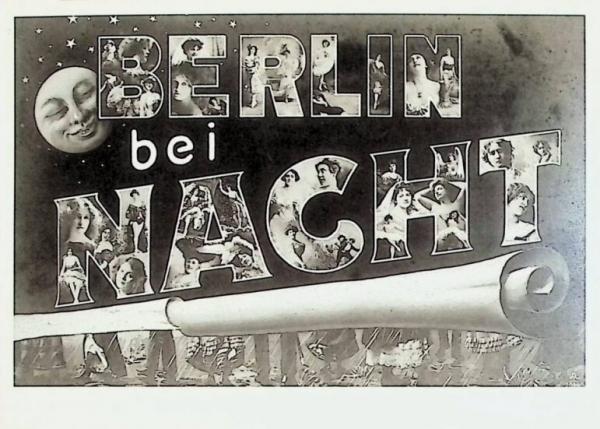
A postcard that reads, "BERLIN bei NACHT" on the front, which translates to "Berlin by night" in English. There is a moon with a face smiling from behind the "B" in "BERLIN", surrounded by stars. Within the words "BERLIN" and "NACHT", there are photographs of various young women. The bottom of the postcard makes it appear as if the "BERLIN bei NACHT" illustration were a poster that was furling up at the bottom, revealing behind it ten sets of legs and shoes walking around in the rain.
The back of the postcard reads vertically, "ANONYME FOTOGRAFIE NR. A19 [Copyright Symbol] SAMMLUNG EIKEMEYER/BERLIN", which translates to, "Anonymous photograph NR. A19 [Copyright Symbol] Eikemeyer collection/Berlin".
-
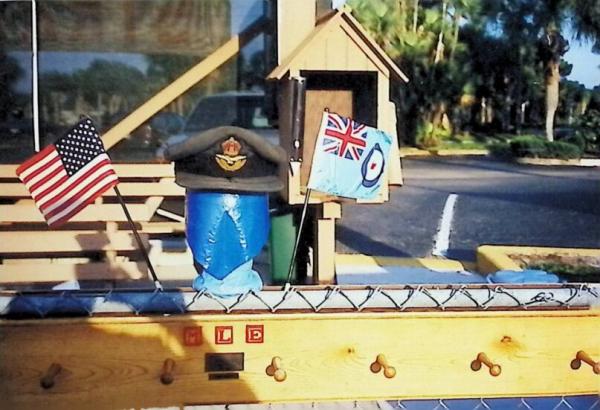
A photograph taken outside of three items erected on the top of a chain link fence, creating what appears to be a memorial of sorts. From left to right, they are the flag of the United States, a blue mannequin head with a World War II Royal Air Force (RAF) peaked cap on top, and the flag of the RAF. Below these three items and mounted to the chain link fence is a wooden coat rack with pegs running horizontally. The letters "M L E" are printed in red at the top of the coat rack. Behind the flags and hat, there appears to be a bench and what is either a birdhouse or mailbox next to it.
-

Description from Amazon: "Few if any works of the past fifty years have moved a broad section of the German public to think about their country's Nazi past as has Daniel Jonah Goldhagen's Hitler's Willing Executioners. The main argument of his book is that Germans committed the unthinkable acts of the Holocaust not because they were forced to but out of a deeply held conviction that killing Jews was morally just. Unwilling Germans? traces the intense and varied reception of a book that has created more heated debate than any other treatment of Germany's genocidal past.
Unwilling Germans? reprints articles that originally appeared in German newspapers, the popular press, and journals, as well as offering original essays. The book traces the initial reactions in Germany to the debate surrounding the U.S. publication of the book, the subsequent reviews and reactions upon the publication of the German translation, and includes contributions by both Goldhagen himself and American historian Christopher Browning. A unique and fascinating collection, Unwilling Germans? will help to sort out the confusing nature of the response to the "Goldhagen Debate"."
-

A Companion to the PBS Television Series. Goodreads description: "This monumental narrative clarifies, analyzes, and demystifies the tragic ordeal of the Vietnam war. Free of ideological bias, profound in its undertsanding, and compassionate in its human portrayals, it is filled with fresh revelations drawn from secret documents and from exclusive interviews with participants-French, American, Vietnamese, Chinese: diplomats, military commanders, high government officials, journalists, nurses, workers, and soldiers. Originally published a companion to the Emmy-winning PBS series, Karnow’s defining book is a precursor to Ken Burns’s ten-part forthcoming documentary series, The Vietnam War. Vietnam: A History puts events and decisions into such sharp focus that we come to understand – and make peace with – a convulsive epoch of our recent history."
-

Description from Lorimer.ca: "First published in 1994, this book offers a brief history of Quebec and the idea of a Quebec nation from 1740 to the time of publication. The story is told through conversations between journalist Gilles Gougeon and seven noted Quebec historians. At a time when many Quebec nationalists continue to believe that they are close to achieving the goal of sovereignty that they have sought for more than two centuries, English Canadians can see for themselves how Quebec historians view their own history.
A bestseller in Quebec, A History of Quebec Nationalism has successfully explained the history of Quebec nationalism and its champions to Quebec readers."
-
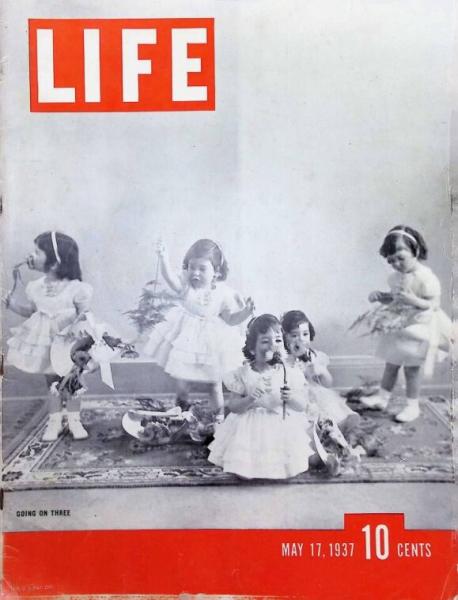
Cover depicts the Dionne Quintuplets; French Canadian Quintuplets popular in the 1930's and were considered the "country's biggest tourist attraction" by the Canadian Encyclopedia. Contents of the magazine were described by oldlifemagazine.com : "Full page Studebaker ad with Bob Hope and Masestro Richard Himber. Interesting full page color Monroe adding-calculator ad. "War Admiral" wins 63rd Kentucky Derby horse race, including photos of jockey Charley Kurtsinger and Samuel D. Riddle, plus more on the Kentucky Derby and other jockeys. Minnesota's last logging drive, Photos at bridge near Nett Lake on Littlefork River. Zeppelin Hindenberg explosion - five full pages of excellent photos. Columbia River salmon fishing fleet puts out to sea. 150 Grand Pianos played at same time for the 125th Grand Piano Festival in Indianapolis. Artist John Kane. Full page color Budweiser beer ad with cave theme. Burmese cremation of a monk. Baby Giant Panda Su-Lin with Mary Bean and Mrs. William H. Harkness Jr. Mrs. Simpson wears fashion by Schiaparelli. Cartoons about British Character by cartoonist Pont, Graham Laidler. Dutch Cigar testers. Girl golfers Clara Callender, Mrs. Brent Potter, Jane Douglas, Joyce Wetherel. A party at the Lake Shore Athletic Club in Chicago, including Joe Lewis, Coleman Clark, Margot Reid, and many others. Lovely full page color Chevrolet car ad, night scene. Crow Indian nation arrow throwing contest. Cute photos of Priscilla Lane surprised in the bath."
-
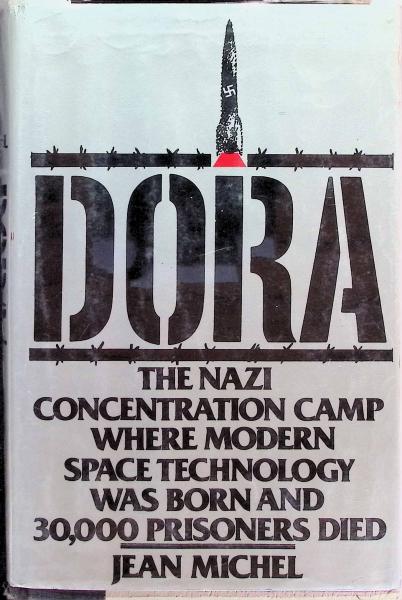
This is the chilling first-person account of a concentration camp that has remained virtually unknown - yet it is the place where the very foundations of the United States and Soviet space programs were laid.
'Dora' was the strangely feminine name that Nazis gave to the camp that inmates and guards of Bergen-Belsen, Auschwitz, and Buchenwald regarded as the worst of all. Jean Michel, a member of the French Resistance who survived Dora tells the horrifying story that historians have avoided.
Hidden rocket facilities were established at Dora to ensure secrecy after the Allied bombing of Pennemünde in 1943. Concentration camp inmates hacked tunnels by hand into the Harz Mountains to house the factories. 60,000 Slaves Built V1s & V2s for the Nazis, laying the foundation of the United States and Soviet space programs and 30,000 died.
Physical Description: 308 pages
-
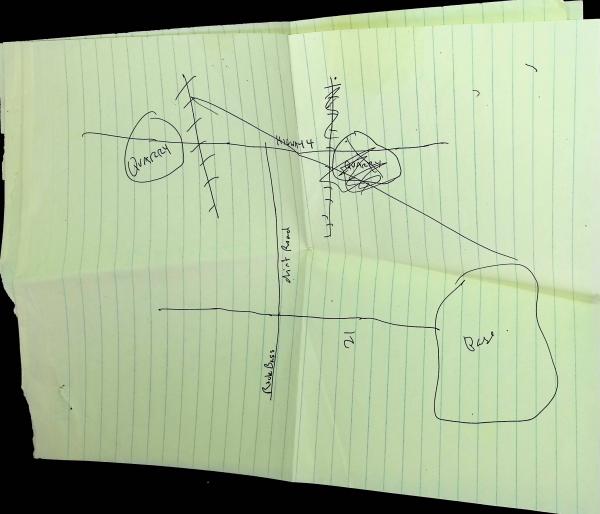
The following is a description of the map in as simple terms as possible. See image for reference:
- "HIGHWAY 4" is written along a horizontal line near the top of the page.
- Intersecting with Highway 4 are two vertical lines covered in dashes, 7 in the first (closest to the left) and 11 in the second, which is also scribbled out.
- On the right of the second vertical line, there is a circular body that was labelled "QUARRY" and is scribbled out.
- On the left of the first vertical line is where this scribbled out circular body was replaced and labelled "QUARRY".
- Connected to Highway 41 is a long vertical line extending downwards which is intersecting with a horizontal line labelled "21") (presumably another highway but not labelled as such).
- On said vertical line, between Highway 41 and 21, it is labelled "dirt Road" and below 21, it is labelled "Rock Bass".
- On the very right of 21 is a larger circular, though not perfectly circular, body that is labelled "Base.".
- There is a diagonal line that connects the Base with the top of the vertical line with 7 dashes closest to the Quarry.
-

Launched by the Third Reich in late 1944, the first ballistic missile, the V-2, fell on London, Paris, and Antwerp after covering nearly two hundred miles in five minutes. The design and construction of this daring and deadly advance in weaponry took place at the German rocket development center at Peenemünde, a remote island off the Baltic Coast.
Now, Michael J. Neufeld gives the first comprehensive and accurate account of the story behind one of the greatest engineering feats of World War II. At a time when rockets were minor battlefield weapons, Germany ushered in a new form of warfare that would bequeath a long legacy of terror to the Cold War era and a tactical legacy that remains essential today.
Both democracy's and communism's ballistic missile and space programs, as well as the SCUD and Patriot missiles of the Gulf War, began in the service of the Nazi State.
-
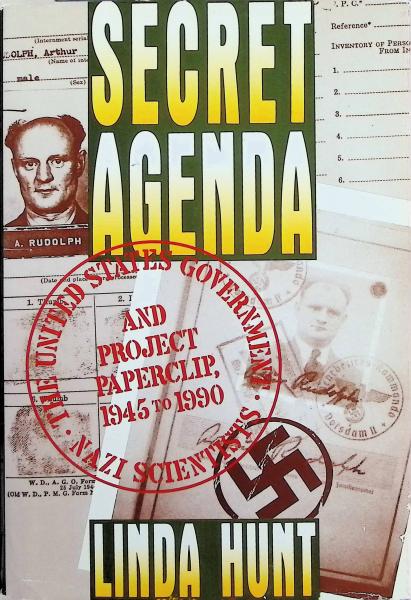
Secret Agenda reads like a thriller, but the story is true: U.S. intelligence officers brought Nazi scientists to America after World War II to work on rockets, jet planes, and chemical warfare.
Here, Hunt, a former CNN investigative reporter, tells a shocking tale: how a branch of the US government deliberately thwarted attempts to bring to justice Nazi scientists who were guilty of war crimes, and who, in at least one case, actually participated in fresh atrocities in the US.
While it is common knowledge that the US used Nazi scientists during the cold war, Hunt reveals for the first time that the project to recruit and utilize Nazi scientific talent- -code-named ``Paperclip''--continued until 1973. In addition, while former Nazi scientists (like Werner von Braun) contributed greatly to the development of rockets, jet planes, and other prodigies of technology, Hunt convincingly demonstrates that several such scientists also participated in ``Dachau-like experiments on over seven thousand U.S. soldiers'' on the effects of LSD and other chemicals at Edgewood, Maryland, between 1947 and 1966.
Moreover, Hunt explains that the US avidly recruited many Nazi scientists, despite their war crimes--including utilization of slave labor and execution of prisoners--and despite the continuing devotion of many to Nazi ideology. Hunt also relates the sordid details of the intelligence community's attempts to prevent bringing these scientists to justice. And, in at least one case, she shows that the program was inimical to US interests--the man who conceived and ran Paperclip was ultimately convicted of selling American defense secrets to the Soviet Union.
An engrossing examination of how a small clique of defense and intelligence officials deliberately subverted stated US policy.
-
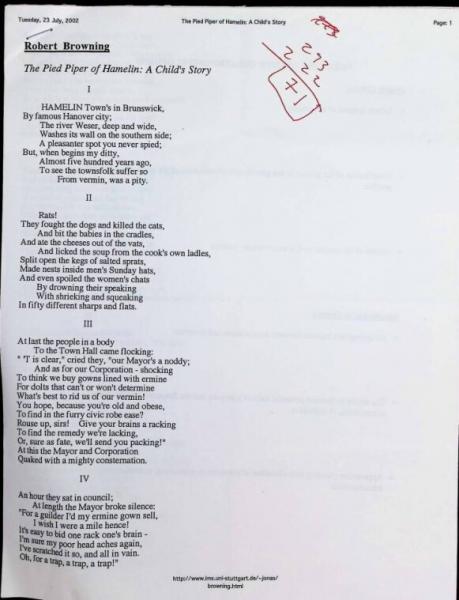
Stanzas from Browning's 1842 children's story "The Pied Piper of Hamlin", spanning two full images. Penned in at the top right corner of the first page is some simple subtraction (293-222=71). The pages are otherwise unmarked. The plot summary from Amazon: "The town is overrun by rats, but the pied piper comes to the rescue when he offers to rid the vermin by playing music. The townspeople thrilled hire the stranger, but when they don't pay him, they lose a lot more" - Amazon
-
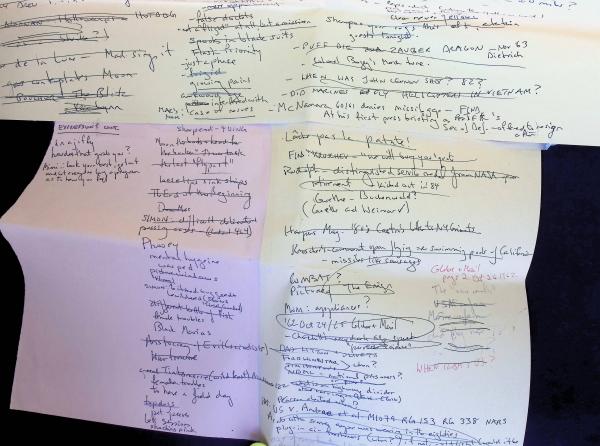
The second transcribed page of omeka ID 18070.
-
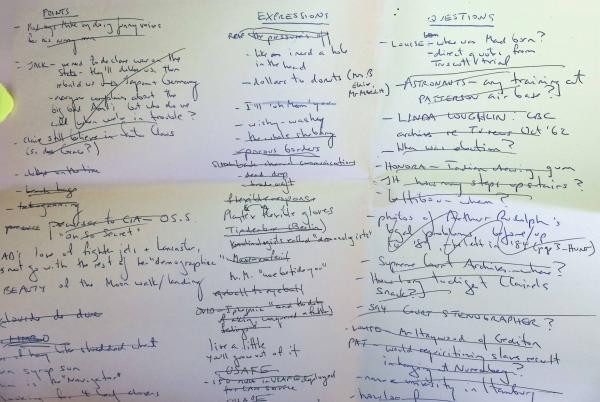
Transcription of a hand written page containing three lists (Points, Expressions, and Questions). Presumably, Points is possible plot points or details concerning the characters as well as worldbuilding; Expressions is a list of possible expressions, sometimes assigned to specific characters, other times not; and Questions seems to be a mix of questions pertaining to character details and real life information AMM has for presumably historical accuracy and world building purposes.
-
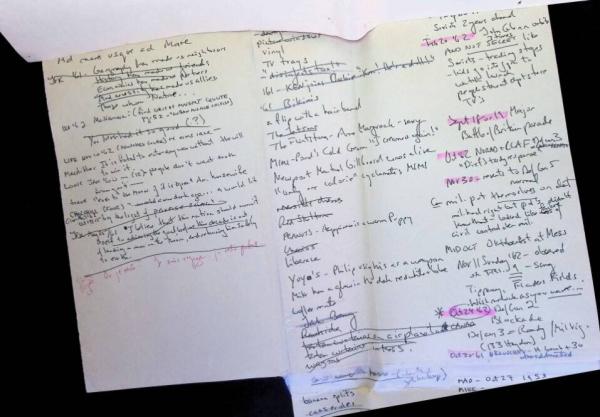
A continuation of "Quotes, Cultural/Texture, Timeline" (Omeka ID 17855), which is the first two pages of an extended list. This includes the last two pages (second photo linked) compounded into one longer list, the second page contents starting immediately after the first in their respective lists.
-
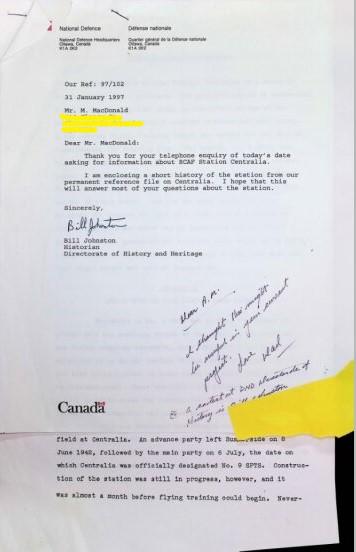
A letter from Bill Johnston of the Canadian Directorate of History and Heritage, containing with it a short history of RCAF Station Centralia. The letter and accompanying documents were sent to a Mr. M. MacDonald (presumably Ann-Marie MacDonald's father), who then sent them to Ann-Marie.
At the top of the letter, it reads, "National Defence Headquarters Ottawa, Canada K1A 0K2", and the French translation beside it, "Quartier general de la Defense nationale Ottawa, Canada K1A 0K2". The letter itself reads,
"Our Ref: 97/102
31 January 1997
Mr. M. MacDonald
[Redacted Address and Zip Code]
Dear Mr. MacDonald:
Thank you for your telephone enquiry of today's date asking for information about RCAF Centralia.
I am enclosing a short history of the station from our permanent reference file on Centralia. I hope that this will answer most of your questions about the station.
Sincerely,
[Bill Johnston's signature]
Bill Johnston
Historian
Directorate of History and Heritage"
Underneath it is a handwritten note from Mr. M. MacDonald to Ann-Marie, "Dear A.M. I thought this might be useful in your current project. Love Dad. PS A contact at DND Directorate of History is Bill Johnston".
The Canada wordmark is in the bottom left corner. An excerpt from the documents can be seen from behind the letter reading, "field at Centralia. An advance party left Summerside on 8 June 1942, followed by the main party on 6 July, the date on which Centralia was officially designated No. 9 SFTS. Construction of the station was still in progress, however, and it was almost a month before flying training could begin. Never-".
-
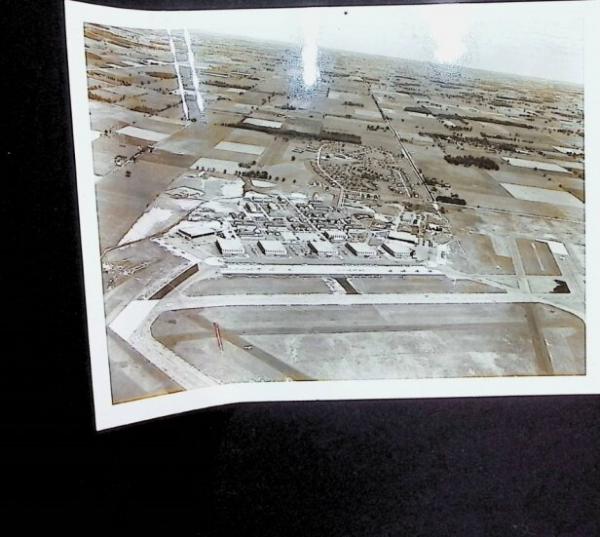
An aerial photograph of RCAF Station Centralia in black and white. It was a Royal Canadian Air Force training base just outside of Centralia, Ontario, Canada.