-
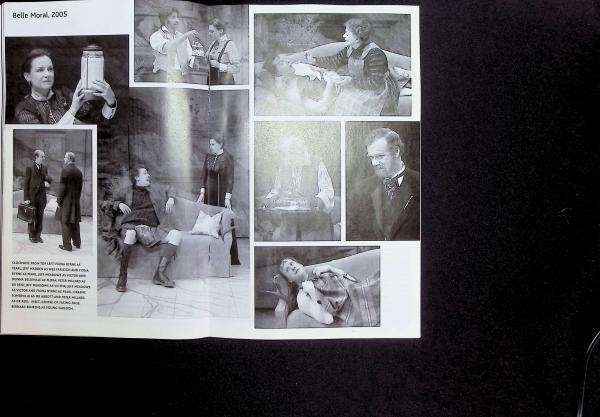
There are seven photos from the 2005 production of Belle Moral. Clockwise from the top left of the page, the photos are as follows:
- Fiona Byrne as Pearl
- Jeff Madden as Wee Farleigh and Fiona Byrne as Pearl
- Jeff Meadows as Victor and Donna Belleville as Flora
- Peter Millard as Dr. Reir
- Jeff Meadows as Victor
- Jeff Meadows as as Victor and Fiona Byrne as Pearl
- Graeme Somerville as Mr. Abbott and Peter Millard as Dr. Reid
Inset, centre of facing page: Bernard Behrens as Young Farleigh
-
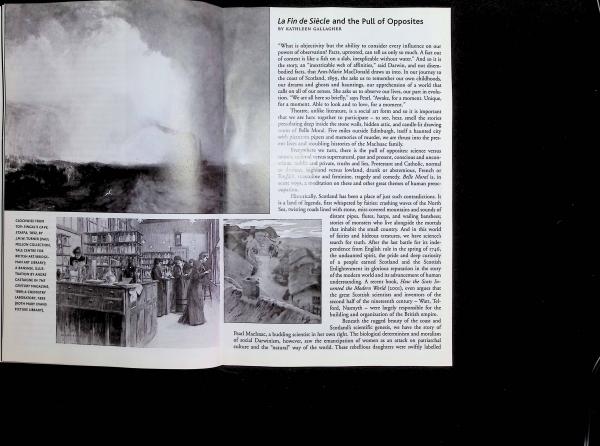
This is an article written by Kathleen Gallagher on Belle Moral. Gallagher discusses the different pull of opposites at work in the play, such as science vs nature, truth and lies, normal and deviant, and rational vs supernatural. She also discusses Scotland being historically a place in which such contradictions occur. Gallagher discusses the Victorian ideals of femininity and various theories, which have influenced the play, such as those of Sigmund Freud.
The first page of this article features 3 photos. Clockwise from the top of the page, these photos are:
- Fingal's Cave, Staffa, 1832, by J.M.W. Turner (Paul Mellon Collection, Yale Centre for British art/Bridgeman Art Library)
- A Banshee, illustration by Andre Castaigne in The Century Magazine, 1889
- A chemistry laboratory, 1893 (Mary Evans Picture Library)
The second page of this article features 5 photos. Clockwise from the top of the page, these photos are:
- Anatomical model of a pregnant woman, 18th century (Bridgeman Art Library)
- Physiognomical examination from Mechanisme de Physionmie Humanie ou Analyse Electrophysiologique des Passions, 1876 (Bridgeman Art Library)
- Two engravings depicting phases of hysteria in a mental patient, 1881 (Mary Evans Picture Library)
- Phrenological study, 19th century (Bibliotheque de la Faculte de Medecine, Paris/Bridgeman Art Library)
The third page of this article features 3 photos. Clockwise from the top left of the page, these photos are:
- The deceased and his mummy protected by Anubis, 3rd century coptic (Louvre, Paris/Bridgeman Art Library)
- "Les Lubins," werewold-like creatures who lurk new cemetaries, illustration by Maurice Sand in Legends Rustiques by George Sand, 1881 (Mary Evans Picture Library)
- Virgil, accompanying Dante to the underworld, throws a sop to Cerberus, the three-headed dog who guards the entrance, engraving by Gustave Dore for Dante's Divina Commedia (Mary Evans Picture Library)
-
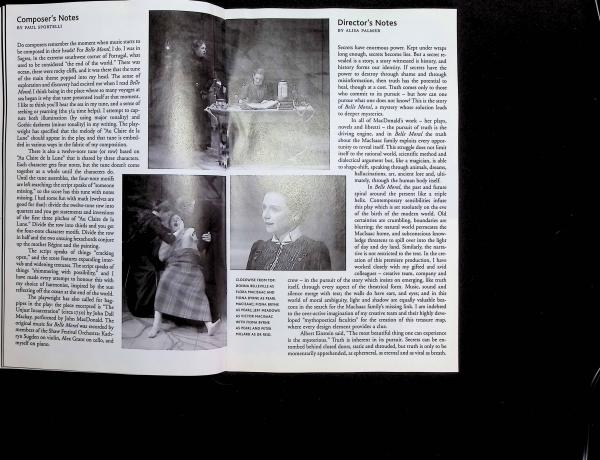
The composer's notes are written by Paul Sportelli. Sportelli discusses specific requests of Ann-Marie MacDonald - such as the inclusion of inclusion of "Au Claire de la Lune" and bagpipes in the play - and also discusses where he was when he began to think about the music for Belle Moral - Sagres, Portugal. The composer also discusses how he incorporated various onomatopoeia from the script into the composition of the music.
The director's notes are written by Alisa Palmer. Palmer's notes discuss how "the pursuit of truth is a driving engine" not only in Belle Moral but the body of Ann-Marie MacDonald's work. They also discuss secrets and how the narrative is not only restricted to the text.
There are also three photos from the production included. Clockwise from the top, these photos consist of:
- Donna Belleville as Flora MacIssac and Fiona Byrne as Pearl MacIssac
- Fiona Byrne as Pearl
- Jeff Meadows as Victor MacIssac with Fiona Byrne as Pearl and Peter Miller as Dr. Reid
-
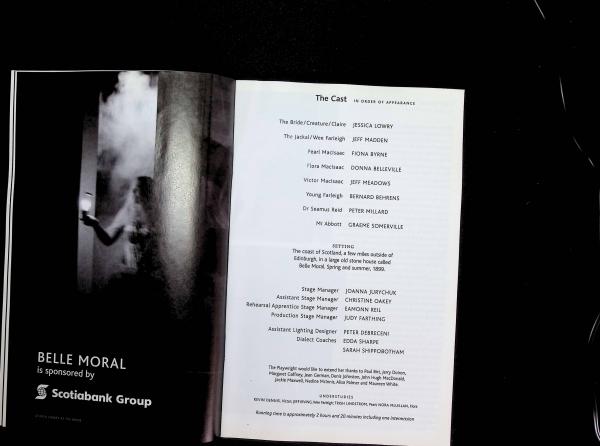
This page is focused on the cast of "Belle Moral." The opposite page features a photo of Jessica Lowry as The Bride. The list of the cast is in order of appearance and is listed as follows:
- The Bride/Creature/Claire - Jessica Lowry
- The Jackal/Wee Farleigh - Jeff Madden
- Pearl MacIsaac - Fiona Byrne
- Flora MacIsaac - Donna Belleville
- Victor MacIsaac - Jeff Meadows
- Young Farleigh - Bernard Behrens
- Dr. Seamus Reid - Petter Millard
- Mr. Abbott - Graeme Somerville.
This page also has information about the play and crew.
- Setting: The coast of Scotland, a few miles outside of Edinburgh, in a large old stone house called Belle Moral. Spring and summer, 1899.
- Stage Manager - Joanna Jurychuk
- Assistant Stage Manager - Christine Oakey
- Rehearsal Apprentice Stage Manager - Eamonn Reil
- Production Stage Manager - Judy Farthing
- Assistant Lighting Design - Peter Debreceni
- Dialect Coaches - Edda Sharpe, Sarah Shippobotham
- Running time is approximately 2 hours and 20 minutes including one intermission
-
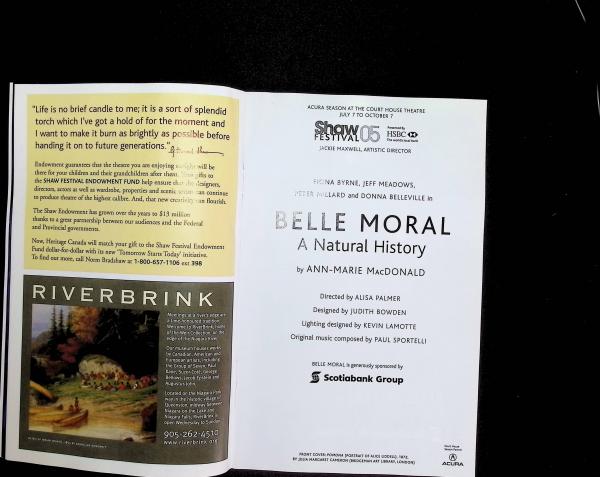
The title page for a write-up on "Belle Moral" which was premiered at the Shaw Festival. This page lists some of the actors in the play - Fiona Byrne, Jeff Meadows, Peter Millard, and Donna Belleville. The page also lists the director, Alisa Palmer, the designer, Judith Bowden, the lighting designer, Kevin Lamotte, and the original music composer, Paul Sportelli. It also lists Scotiabank Group as the sponsor of the play.
-
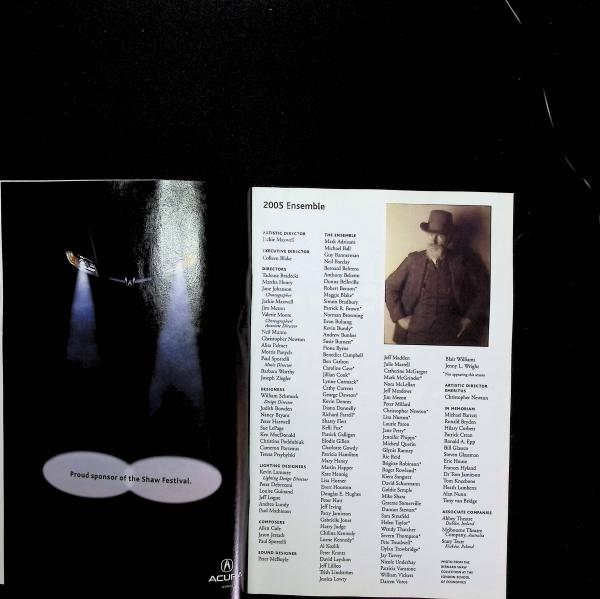
This is a list of the 2005 ensemble for the 2005 Shaw Festival season. This list also includes the artistic director, executive director, directors, designers, lighting designers, composers, the sound designer, the artistic director emeritus, associate companies, and a Memoriam list. This page also includes a photo from the Bernard Shaw collection at the London School of Economics.
-
This is the cover page of the 2005 Shaw Festival season pamphlet. The cover contains information on HSBC sponsoring the Shaw Festival. This page has a few sentences about the festival as well as some information on the sponsor. There is an illustration of flowers at someone's while they are under the spotlight on stage.
There is another page which also states it is sponsored by HSBC and which details the 10 plays that will run during this season of the Shaw Festival - including "The Arab's Mouth." This page includes a short blurb on how the plays for each year's season are chosen.
-
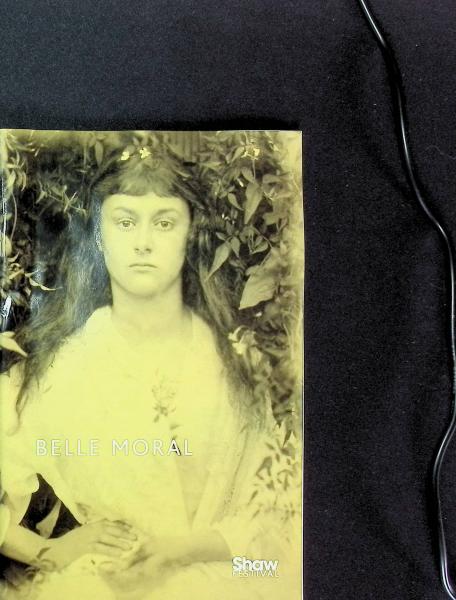
This is a photo of the first edition cover of Belle Moral, published by Playwrights Canada Press. There is a small watermark which says "Shaw Festival" - the threatre festival where the play premiered in 2005.
-
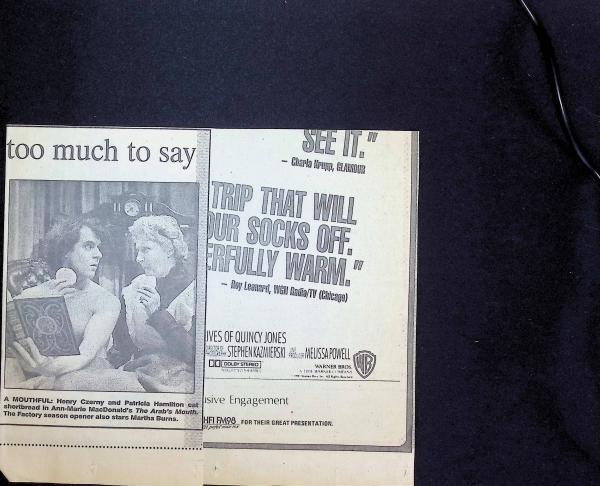
This is a photo of Henry Czerny who plays Victor, and Patricia Hamilton, who plays Aunt Flora, eating shortbread in character. The caption of the photo also mentions that "The Arab's Mouth" is the season opener for The Factory Theatre, and that the play also stars Martha Burns.
-
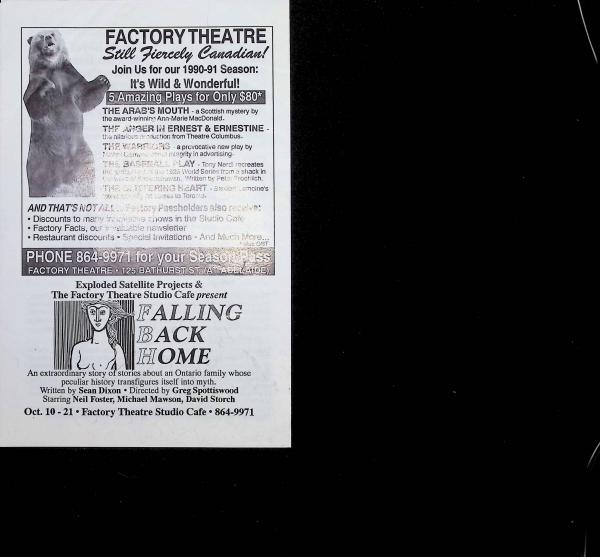
The back of this pamphlet details 5 plays which ran during the 1990-91 theatre season. It also features information on season passes for 1990-91.
-
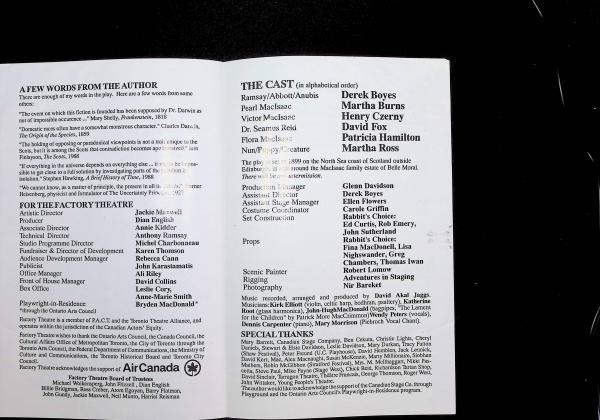
This is the inside of the Factory Theatre pamphlet on "The Arab's Mouth." It contains a few words from Ann-Marie MacDonald who instead quotes Mary Shelly, Charles Darwin, Iain Finlayson, Stephen Hawking, and Werner Heisenberg. The page opposite this one contains a list of the cast in alphabetical order as well as information about various departments who helped with the production of the play. Finally, there is a special thanks section.
-
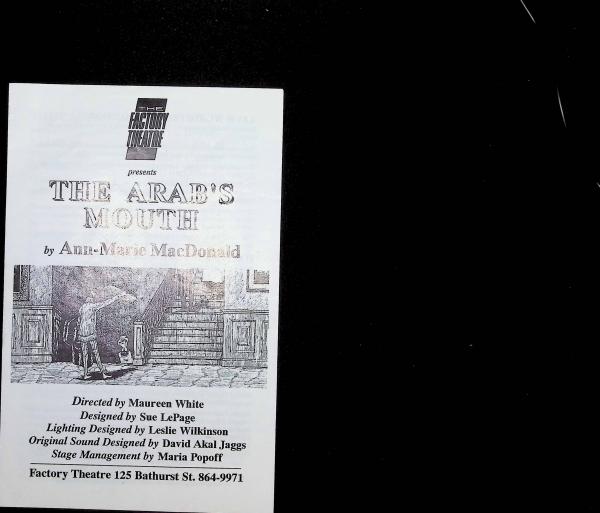
This is the cover of a Factory Theatre pamphlet from "The Arab's Mouth." The cover has an illustration of the playas well as a list of who directed, who did the general design, as well as the lighting design, original sound design, and stage management for the play. The pamphlet also has the address and phone number for The Factory Theatre.
-
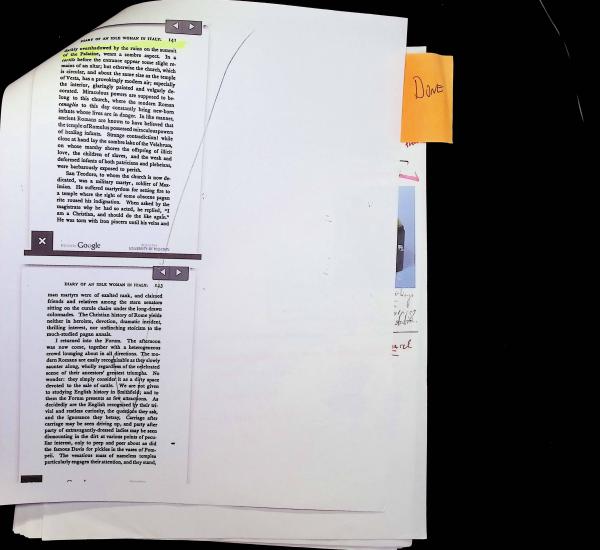
This is the fourteenth page of 14 which concerns Henry and Mae's meeting in Rome and subsequent honeymoon. There are no notes on this page, rather some of AMM's prose is hightlighted and there is a large check mark on this page.
-
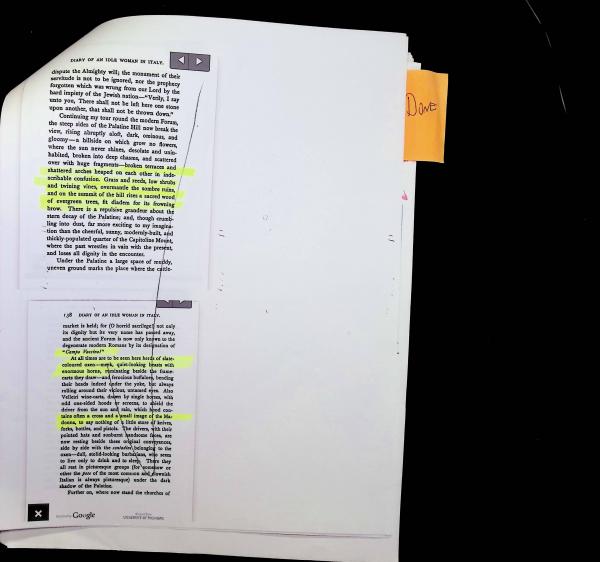
This is the thirteenth page of 14 which concerns Henry and Mae's meeting in Rome and subsequent honeymoon. There are no notes on this page, rather some of AMM's prose is hightlighted and there is a large check mark on this page.
-
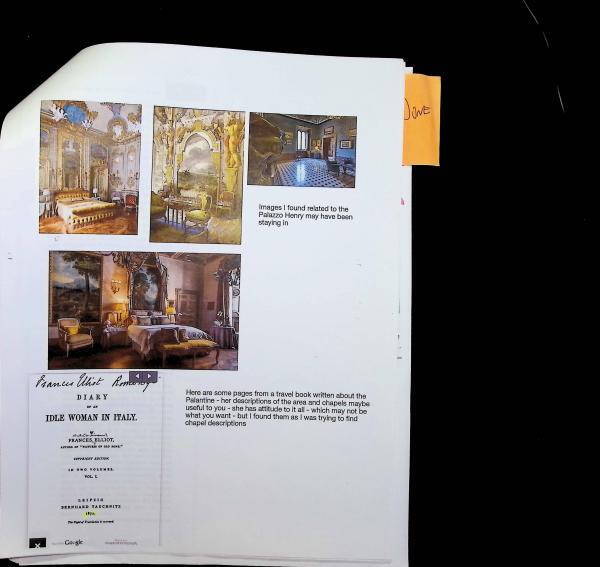
This is the twelfth page of 14 which concerns Henry and Mae's meeting in Rome and subsequent honeymoon. There are three pictures of bedrooms related to where Mae and Henry were staying in Rome. Notes on the page read:
- Images I found related to the Palazzo Henry may have been staying in.
- Here are some pages from a travel book written about the Palantine - her decsriptions of the area and chapels maybe useful to you - she has attitude to it all - which may not be what you want - but I found them as I was trying to find chapel descriptions.
The cover of a book titled "Diary of an Idle Woman in Italy" written by Frances Elliot is also included.
-
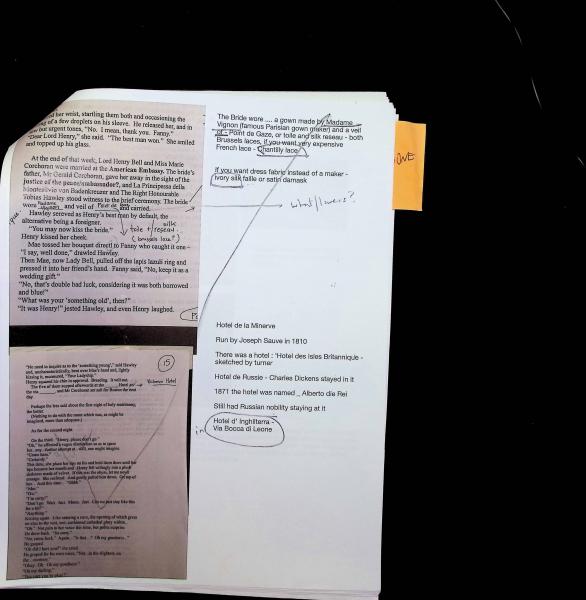
This is the eleventh page of 14 which concerns Henry and Mae's meeting in Rome and subsequent honeymoon. Notes on the page read:
- The Bride wore .... a gown made by Madame Vignon (famous Parisian gown maker) and a veil of - Point de Gaze, or toile and silk reseau - both Brussels laces, if you want a very expensive French lace - Chantilly lace
- If you want dress fabric instead of a maker - ivory silk faille or satin damask
- What flowers?
- Hotel de la Minerve. Run by Joseph Sauve in 1810
- There was a hotel: 'Hotel des Isles Britannique - sketched by Turner
- Hotel de Russie - Charles Dickens stayed in it
- 1871 the hotel was named Alberto die Rei
- Still had Russian nobility staying at it
- Hotel d' Inghilterra - Via Bocca di Leone
-
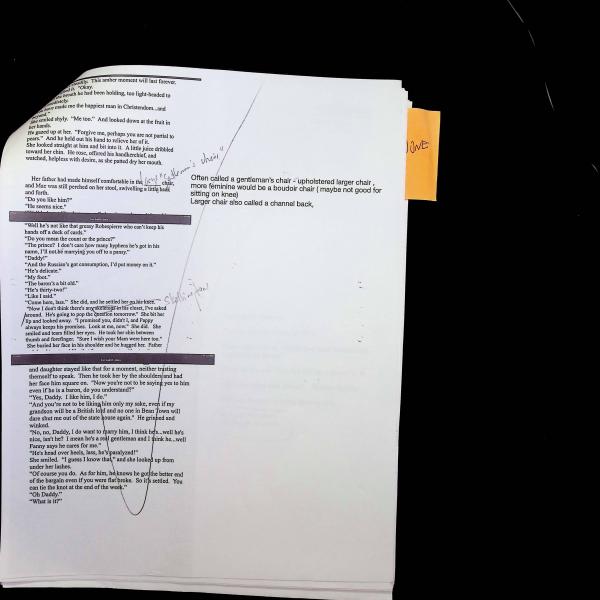
This is the tenth page of 14 which concerns Henry and Mae's meeting in Rome and subsequent honeymoon. Notes on the page read:
- Large "setheman's chair"
- Often called a gentleman's chair - upholstered larger chair, more feminine would be a boudoir chair (maybe not good for sitting on knee)
- Large chair also called a channel back
- Skellingtons
-
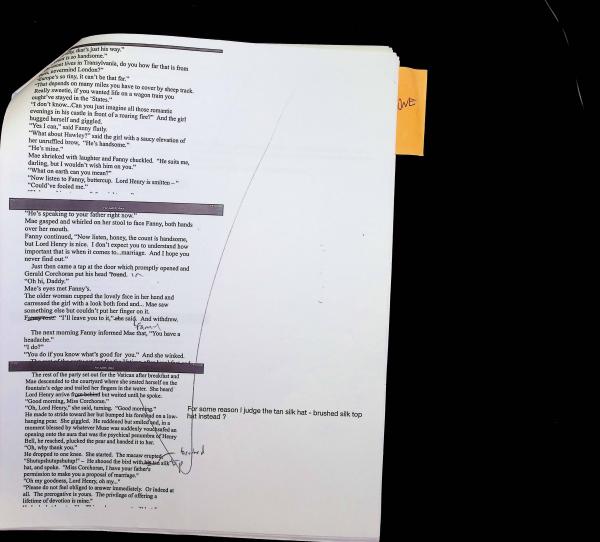
This is the ninth page of 14 which concerns Henry and Mae's meeting in Rome and subsequent honeymoon. Notes on the page read:
- For some reason I judge the tan silk hat - brushed silk top hate instead?
-
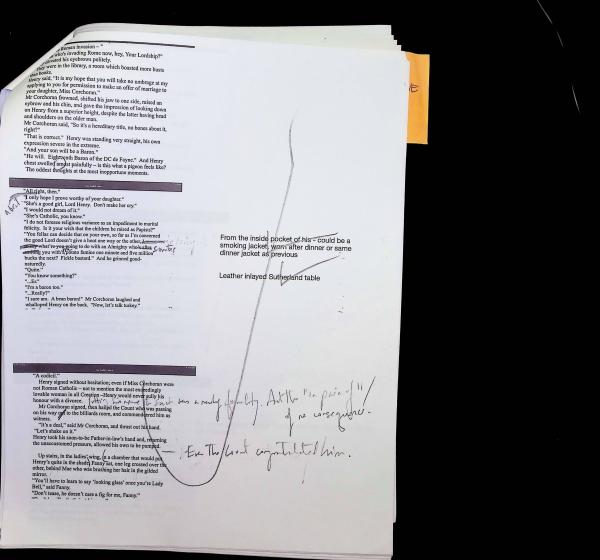
This is the eighth page of 14 which concerns Henry and Mae's meeting in Rome and subsequent honeymoon. Notes on the page read:
- From the inside pocket of his - could be a smoking jacket, worn after dinner or same dinner jacket as previous
- Leather inlayed Sutherland table
- Putting his name to such was a ? formality. ? the "on pain of" / of no consequence.
- Even The Count congradulated him.
-
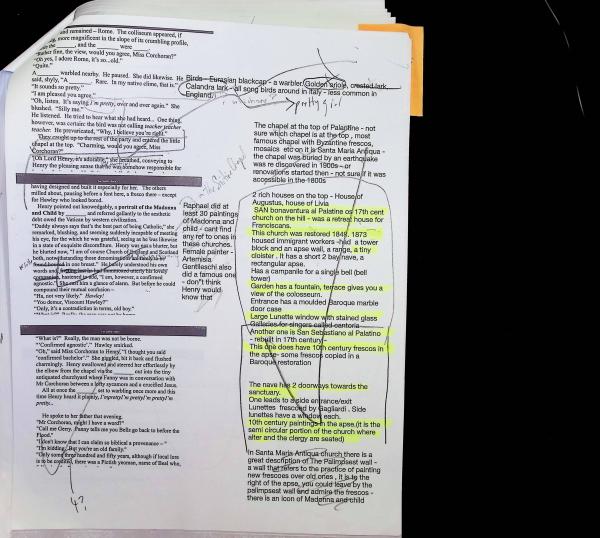
This is the seventh page of 14 which concerns Henry and Mae's meeting in Rome and subsequent honeymoon. Notes on the page read:
- Bird - Eurasian blackcap - a warbler. Golden oriole, crested lark, Calandra lark - all song birds around in Italy - less common in England. ?which one? -> pretty girl
- The chapel at the top of Palantine - not sure which chapel is at the top, most famous chapel with Byzantine frescos, mosaics, etc on it is Santa Marie Antiqua - the chapel was buried by an earthquake was re discovered in 1990s - or renovations started then - not sure if it was accessible in the 1800s
- 2 rich houses on the top - House of Augustus, house of Livia. SAN bonaventura al Palatine os 17th cent church on the hill - was a retreat house for Franciscans. The church was restrored in 1849. 1873 housed immigrant workers - had a tower block and an apse wall, a range, a tiny cloister. It has a short bay nave. a rectrangular apse. Has a campanile for a single bell (bell tower). Garden has a fountain, terrace gives you a view of the colosseum. Entrance has a moulded Baroque marble door case. Large Lunette window with stained glass Galleries for singers called cantor. Another one is San Sebastiáno al Palatino - rebuilt in 17th century - This one does have 10th century frescos in the apse - some frescos copied in a Baroque restoration.
- Raphael <- the Sistine Chapel - did at least 30 paintings of Madonna and child - can't find any ref to ones in these churches. Female painter - Artemisia Gentileschi also did a famous one - don't think Henry would know that
- The nave has 2 doorways towards the sanctuary. One leads to a side entrance/exit Lunettes frescoed by Gagliardi. Side lunettes have a window each. 10th century paintings in the apse. (it is the semi circular portion of the church where alter and the clergy are seated)
- In Santa Maria Antiqua church there is a great description of The Palimpsest wall - a wall that refers to the practice of painting new frescos over old ones, it is to the right of the apse, you could leave by the palimpsesy wall and admire the frescos - there is an icon of Madonna and child.
-
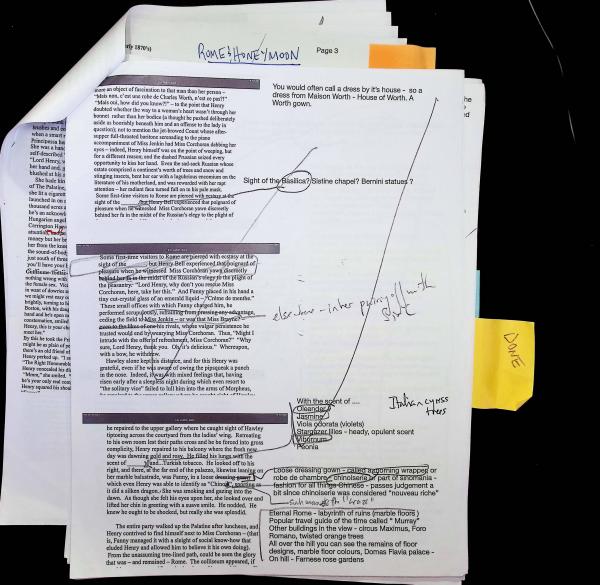
This is the sixth page of 14 which concerns Henry and Mae's meeting in Rome and subsequent honeymoon. Notes on the page read:
- You would often call a dress by it's house - so a dress from Maison Worth - House of Worth. A Worth gown
- Sight of the Basilica? Sistine chapel? Bernini statues?
- With the scent of Oleander, Jasmine, Viola odorata (violets), stargazer lilies - heady, opulent scent, Viburnum, Peonia
- Loose dressing gown - called a morning wrapper or robe de chamber - chinoiserie or part of sinomania - fashion for all things Chinese- passes judgement a bit since
chinoiserie was considered "nouveau riche."
- Eternal Rome - labyrinthite of ruins (marble floors). Popular travel guide of the time called "Murray." Other buildings in the view - circus Maximus, Foro Romano, twisted orange trees. All ober the hill you can see the remains of floor desihns, marble floor colours, Fomas Flavia palace - On hill - Farnese rose gardens.
-
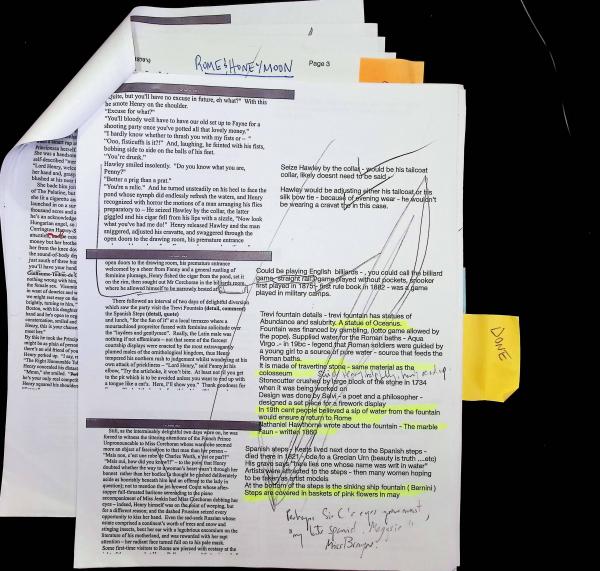
This is the fifth page of 14 which concerns Henry and Mae's meeting in Rome and subsequent honeymoon. Notes on the page read:
- Seize Hawley by the collar - would be his tailcoat collar, likely doesn't need to be said
- Hawley would be adjusting either his tailcoat or his silk bow tie - because of evening wear - he wouldn't be wearing a cravat in this case
- Could be playing English billiards -, you could call the billiard game straight rail - game played without pockets, snooker, first played in 1875 - first rule book in 1882 - was a game played in military camps
-Trevi fountain details - trevi fountain has statues of Abundance and salubrity. A statue of Oceanus. Fountain was financed by gambling (lotto game allowed by the pope). Supplied water for the Roman baths - Aqua Virgo, - in 19 bc - legend that Roman soldiers were guided by a young girl to a source of pure water - source that feeds the Roman baths. It was made of travertine stone - same material as the colosseum. Stonecutter crushed by large block of the stone in 1734 when it was being worked on. Design was done by Salvi - a poet and a philosopher designed a set piece for a firework display. In the 19th cent people believed a sip of water from the fountain would ensure a return to Rome. Nathanial Hawthorne wrote about the fountain - The marble Faun - written 1860
- Spanish steps - Keats lived next door to the Spanish steps - died there in 1821 - ode to a Grecian Urn (beauty is truth...etc). His grave says "here lies one whose name was writ in water." Artists were attracted to the steps - then many women hoping to be taken as artist models. At the bottom of the steps is the sinking ship fountain (Bernini) Steps are covered in baskets of pink flowers in may.
-
This is the fourth page of 14 which concerns Henry and Mae's meeting in Rome and subsequent honeymoon. This page has no notes but a large check mark is drawn over the prose.
-
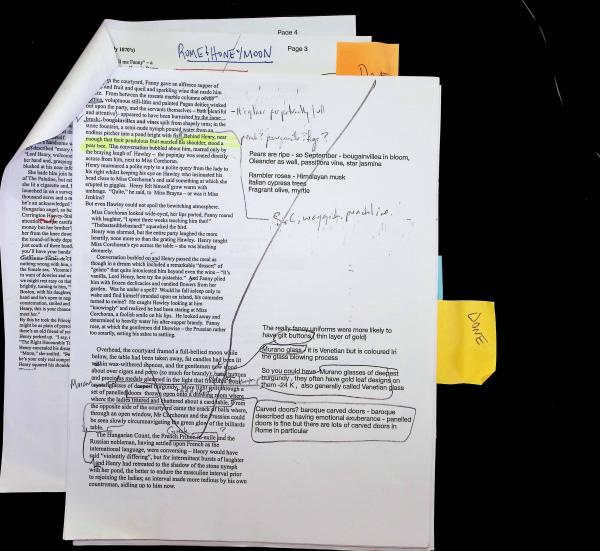
This is the third page of 14 which has notes on Henry's visit to Rome and Henry and Mae's honeymoon. Various notes on the right-hand side of the page include:
- His glass perpetually full
- Peach? Pomegranate? Figs?
- Pears are ripe - so September - bougainvillea in bloom, Oleander as well, passiflora vine, star jasmine
- Rambler roses - Himalayan musk
- Italian cypress trees
- Fragrant olive, myrtle
- The really fancy uniforms were more likely to have gilt buttons (thin layer of gold)
- Murano glass - it is Venetian but is coloured in the glass blowing process
- So you could have Murano glasses of deepest burgundy, they often have gold leaf deigns on them - 24 K, also generally called Venetian glass
- Carved doors? baroque carved doors - baroque described as having emotional exuberance - panelled doors is fine but there are lots of carved doors in Rome in particular
-
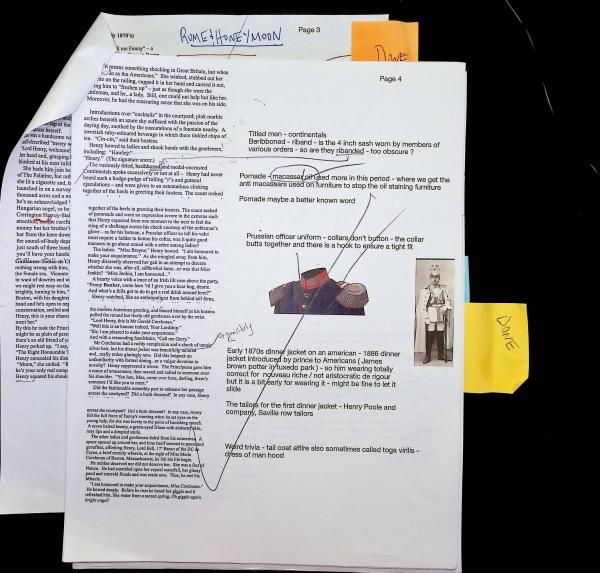
This is the second page of 14 which has notes on Henry's visit to Rome and Henry and Mae's honeymoon. Various notes on the right-hand side of the page include:
- Titled men - continentals
- Beribboned - riband - is the 4 inch sash work by members of various orders - so are they ribanded - too obscure?
- Pomade -macassar oil used more in this period - where we get the anti macassars used on furniture to stop oil staining furniture
- Pomade maybe a better known word
- Prussian officer uniform - collars don't button - the collar butts together and there is a hook to ensure a tight fit
- There are two photos of a Prussian officer uniform
- Early 1870's dinner jacket on an american - 1886 dinner jacket introduced by prince to Americans (James brown potter in tuxedo park) - so him wearing totally correct for nouveau riche / not aristocratic de rigour but it is a bit early for wearing it - might be fine to let it slide
- The tailors for the first dinner jacket - Henry Poole and company, Saville row tailors
- Weird trivia - tail coat attire also sometimes called toga virilis - dress of man hood