Curator's talk 1-2
evoking quotidian perfection in the work of Jaumes Privat
Stuart Reid, February 2025
Quotations from J. Privat’s Cuttings (Small Walker Press 2025) translated from Occitan into English by C. Parayre.
“there is / a song / a song / of nothing / a semblance of song / for nothing / and yet / all this” (Privat)
1.
The unfurled paper scroll of a visual painting/poem by Jaumes Privat, laid out on the concrete floor, curled and folded upon itself, at once revealing and occluding, colour and marks – reminds me that language is like a meandering thread in the fabric of life. Appearing and disappearing, unfolding and searching, a running current from the creator or speaker to the welcoming recipient, the one reading, the ear. Encoding memory into sounds, notes, symbols, and marks – language is a codification system that documents the passing of time, the march of ages, the lineage of the ancestors that came before. It is part of our identity, embedded in us like the DNA pattern that dictates the requisite replication of our cells, telling them how to create a finger or a lock of hair. We are born the progeny of an extensive lineage – a vector sent forth in time to carry on, flourish, and fulfil the promise of those that went before. What we say may feel like personal expression, but the tools we employ have been honed and shaped through centuries preceding.
It is not so much the meaning of the words that is important to understand – that is one part of comprehending the act of writing or speaking. Awareness of presence, the energy that passes between the speaker and the listener, the circumstances of encounter, the gesture, the tone are all important signifiers of the message. The sound of a voice speaking or in song has a powerful vibration and energy that exists in linear time, resonating in waves that traverse space, rippling out beyond the immediate sphere perhaps to the ends of the universe, as advances in quantum physics suggest. The intent of communication is an energetic commitment that connects the individual with something outside itself – like an offering or blessing, like worship in a song or a poem. Give and take, transactional, exchanging energy and intent – communication is holistically much more than language.
“i’m suffocating / in / columns / this coffee / in the evening / scratches / my / iris” (Privat)
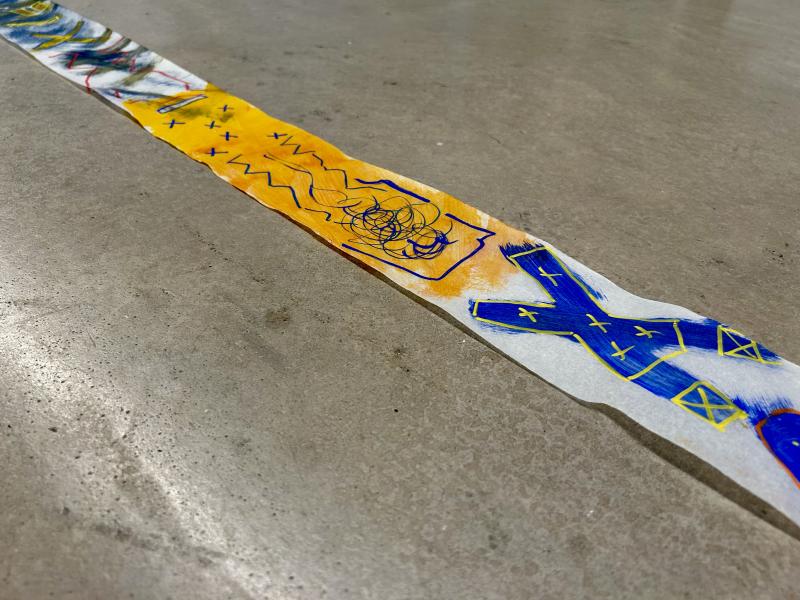
Detail of painted paper scroll by Jaumes Privat
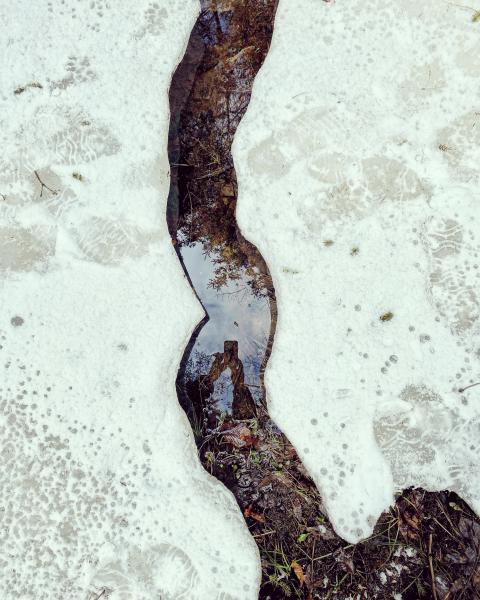
Instagram image @sjohnreid
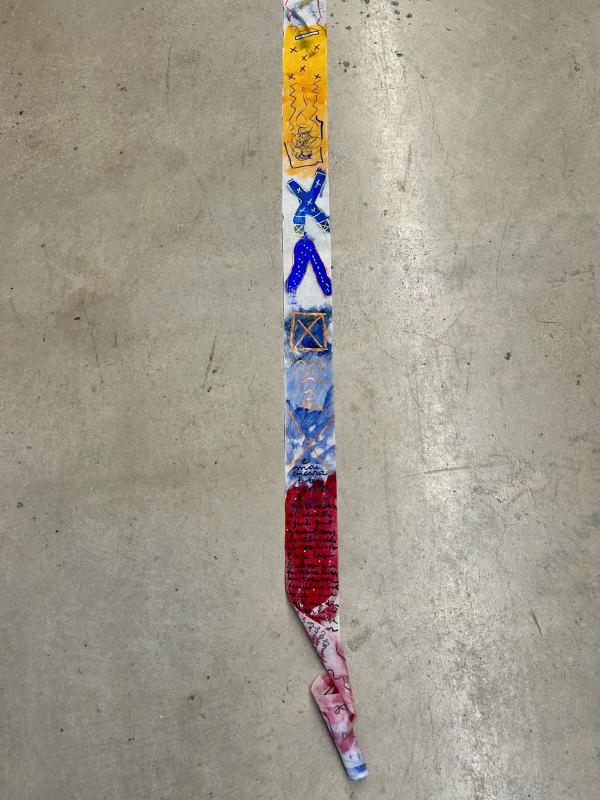
Detail of paper scroll by Jaumes Privat

Instagram image @sjohnreid
2.
As a Scot, born in Dundee, I speak English and that is the language of a colonialist empire. That is the only language that I speak fluently and comprehend readily. Even though I studied French in school for many years, I never broke through the boundary of my halting inquiry to the state of using the language to actively speak, write, and read. Being Canadian, I feel the language to be familiar – I know the sounds, can make my way through a text and I can even sing along to “Pour que tu m’aimes encore”. There are many languages that I have tasted and experimented with in my travels: French, Spanish, Portuguese, Italian. From my cursory understanding of other tongues, I sense common roots, similar sounds for ideas, the musicality and humour in each language to have distinct and overlapping qualities.
During the COVID pandemic, I was stuck at home with lots of time on my hands, utilizing the all-important portal of an iphone to stay connected to the world. I began to dig into my ancestral heritage by teaching myself Scottish Gaelic on the app called Duolingo. Not that this language is something that I would have any occasion to speak in my day to day life, but, because the sounds and the roots are echoes for me of my dear father and his father and his father. Did my grandad sing to me in Gaelic? I seem to recall he did. This language is a system of letters and codes that is like an intimate whisper in my ear.
Scottish Gaelic is the indigenous language of the Scottish Highlands, which declined significantly in use due to political and social pressures, particularly following the Jacobite uprisings in 1745 and the Highland Clearances, 1750 to 1860, leading to the dominance of English as the primary language in Scotland. Those songs my grandad sang seemed innocent enough, childlike rhyming, images of nature and landscape. I know now that they were a bit of resistance, a quiet testimonial of sounds and melodies that were uniquely ours, apart from the dictates of an imposed rectilinear grid on our land and the foreign concept of ownership that ended the commons. Our comforting songs retained an identity that was ours to hold close while resisting the assimilation of the common dominator.
Scottish Gaelic is a Goidelic language, a Celtic branch of the Indo-European family of languages. It is very complex as a written language, often not translatable by phonetics, sounding the letters that form the word. It is more about recognizing the image of the word and its association with another sound. There are many words that I recall obliquely from the family vernacular that I heard growing up. In Duolingo, I surprise myself at how I seem to have an innate sense of the vocabulary, the sounds and music of Gaelic – an inherent ease in memorization and recognition. Without thinking, I still say a shortened “ta” instead of “thank you” that is related to tapadh leat (tapala).
Privat uses Occitan in his work, once the everyday language of southern France – a Medieval romance language that predates modern French and was banned to erase regional differences. Occitan was the language of the troubadours – the poets, composers, musicians from the late eleventh to the thirteenth centuries that travelled the lands surrounding Southern France, Northern Spain and Italy. They visited the courts of the period and sang of love and human refinement. The word troubadour is a French form derived ultimately from the Occitanian trobar, “to find,” “to invent” – these poets were forging a new style, a new love language. Trobar clus was a variety of the poetry of the troubadours that was particularly obtuse, where words were used for their sound rather than their meaning. Clus is “closed”, not totally generous in giving everything away – resisting and retaining. The words are disappearing, the artist is conscious of occlusion.
“nothing cuts / and / and does not cut / anything foam / the incision / the scythe the cut” (Privat)
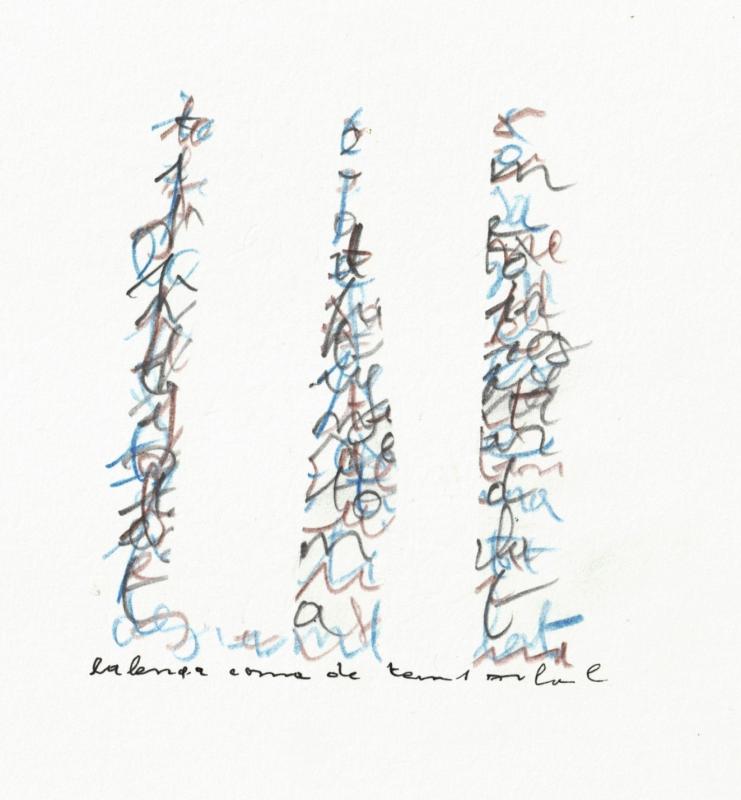
Drawing on paper by Jaumes Privat
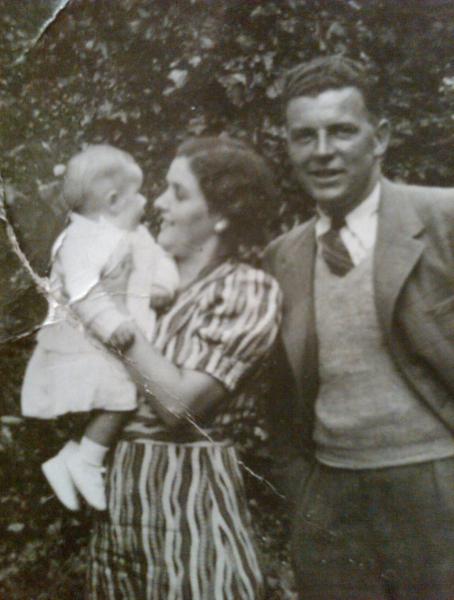
My grandparents with my father, Monifeith, Scotland, c. 1940
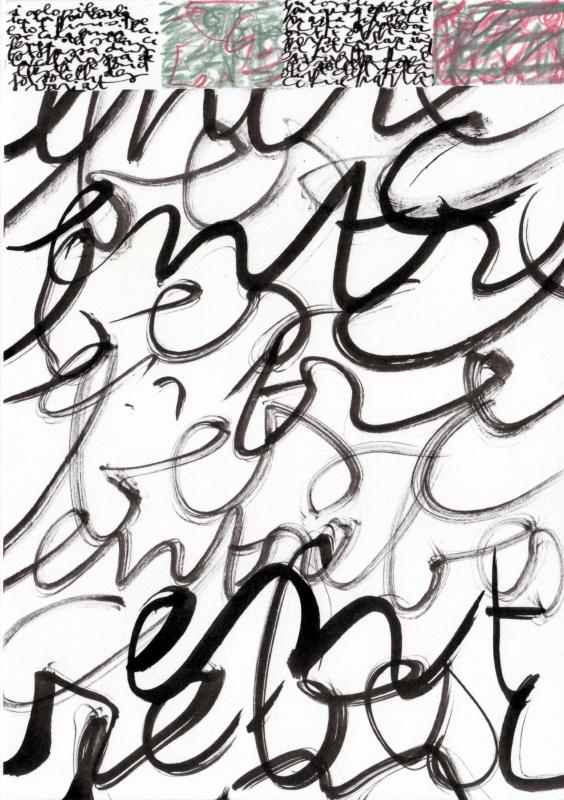
Detail of ink drawing on paper by Jaumes Privat
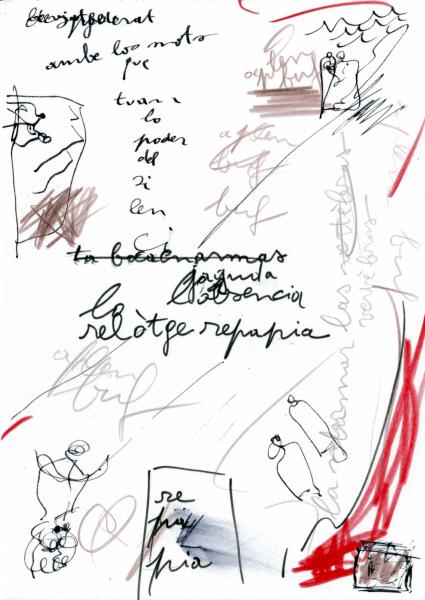
Detail of ink drawing on paper by Jaumes Privat